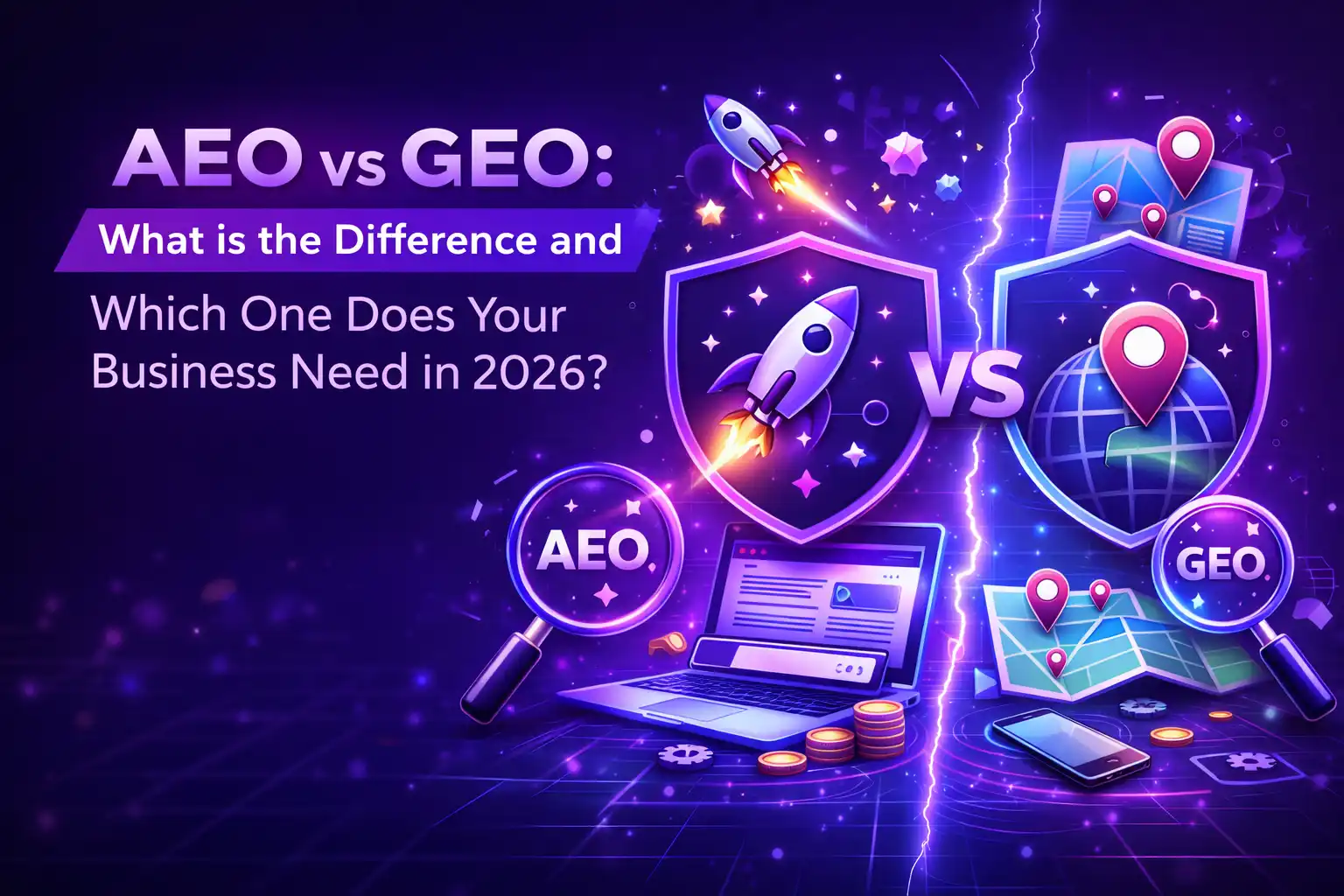
Quick Answer: AEO vs GEO is one of the most debated topics in AEO SEO 2026. AEO (Answer Engine Optimization) helps your content appear as a direct fact in voice search and AI snippets. GEO (Generative Engine Optimization) helps your brand get cited inside AI-generated explanations like ChatGPT and Google AI Overviews. Most businesses need both, but they require different content strategies.
If you have been following SEO news in 2026, you have probably seen the terms AEO and GEO thrown around everywhere. Sometimes they are used interchangeably. Most of the time, people explaining them are making it more complicated than it needs to be.
Here is the honest truth about AEO vs GEO SEO: they are not the same thing. They serve different purposes, work on different types of content, and require different strategies. Confusing the two means you end up optimizing for neither.
This guide breaks down exactly what is AEO in SEO, what is GEO in SEO, how they differ, and what your business actually needs in 2026.
What is AEO in SEO – Answer Engine Optimization Explained
If you are asking what is AEO in SEO, here is the simplest answer: Answer Engine Optimization is the practice of optimizing your content to appear as a direct, factual answer in AI-powered search tools.
Think about how Siri, Alexa, or the featured snippet at the top of Google works. Someone asks a question. The engine fetches one clear, definitive answer. That is AEO in action.
AEO is rooted in something called the “fact repository”, a concept Google actually patented back in 2006. Long before AI Overviews existed, Google was building systems to store and retrieve structured facts with confidence. Today, those same systems power voice search, featured snippets, and AI direct answers.
For AEO to work, your content needs what researchers call “confidence anchors” unnuanced, structured facts that an engine can retrieve without risk of being wrong.
AEO works best for
- Who, what, when, where questions
- Definition-based queries like “What is technical SEO?”
- Simple factual answers like “How long does SEO take?”
- Voice search queries
Example of AEO-optimized content
If someone asks, “What is answer engine optimization?” your page should have a clean, direct sentence near the top:
Answer engine optimization (AEO) is the process of structuring content so AI search engines can extract and present it as a direct answer to user queries.
That is a confidence anchor. It is specific, provable, and machine-readable.
According to research by BrightEdge, AI-powered answer features now appear on 48% of all Google searches. If your content is not structured for AEO SEO 2026, you are invisible to nearly half of all search queries.
What is GEO in SEO – Generative Engine Optimization Explained
If you are asking what is GEO in SEO, here is the clear answer: Generative Engine Optimization is the practice of optimizing your content to be cited and summarized inside AI-generated explanations, not just fetched as a single fact.
This is what happens when someone asks ChatGPT, Perplexity, or Google AI Overviews a complex question and gets a multi-paragraph synthesized answer. GEO SEO 2026 is about becoming one of the sources that AI uses to build that answer.
GEO was formally defined in 2023 by researchers at Princeton University, Georgia Tech, and the Allen Institute for AI. Their study found that AI engines do not just look for facts, they look for content that explains relationships, adds context, and demonstrates unique authority on a topic.
In the AEO vs GEO comparison, AEO is about being the fact. GEO is about being the trusted authority that explains the facts.
GEO works best for
- Complex how and why questions
- Topic explanations like “How does local SEO work?
- Comparison queries like “SEO vs Google Ads, which is better?
- Industry-specific authority content
What makes GEO content work
GEO SEO 2026 engines prioritize content that shows relationships between concepts, not just definitions. If your article explains that “local SEO improves Google Maps rankings which directly increases walk-in customers and phone calls” you are showing a relationship. That is what generative AI trusts enough to synthesize and cite.
According to the Princeton and Georgia Tech GEO study, content with unique insights, statistical data, and expert citations is significantly more likely to be cited in AI-generated responses than generic informational content.
AEO vs GEO – Key Differences Explained
Understanding AEO vs GEO SEO becomes much clearer when you compare them side by side across every major factor:
- Goal: AEO – Be the direct answer. GEO – Be cited in the AI explanation.
- Content type: AEO – Structured facts and definitions. GEO – Authoritative explanations and relationships.
- AI tools: AEO – Siri, Alexa, Google snippets. GEO – ChatGPT, Perplexity, Google AI Overviews.
- Query type: AEO – Simple who, what, when questions. GEO – Complex how and why questions.
- Content format: AEO – Short and direct sentences. GEO – Long-form, in-depth, data-backed.
- Schema needed: AEO – FAQPage, HowTo, Speakable. GEO – Article, BlogPosting, Person, Organization.
- E-E-A-T requirement: AEO – Moderate. GEO – Very High.
Where AEO vs GEO Overlap
Here is where the AEO vs GEO debate gets interesting, and where most businesses can win without doing double the work.
Both AEO and GEO reward the same foundational signals: E-E-A-T (Experience, Expertise, Authoritativeness, Trustworthiness), structured data, clean technical SEO, and content that directly answers user questions.
The difference is depth. AEO needs your content to be clean and direct. GEO needs your content to be clean, direct, AND authoritative with unique perspectives.
This means your AEO vs GEO SEO strategy can serve both if you structure it correctly:
- Start with a clear, direct answer at the top of every page. This serves AEO
- Then build a comprehensive, expert-level explanation below it, this serves GEO
- Add FAQ sections with a structured schema, which serves both
- Link to authoritative external sources and get links from authoritative sites. This serves both
Does Your Business Need AEO or GEO in 2026?
The honest answer to the AEO vs GEO question is that most businesses need both, but the priority depends on what you sell and how your customers search.
Focus on AEO SEO 2026 first if
- Your customers ask simple factual questions before buying: “What is the cost of SEO in Dehradun?
- You have a local business and want to appear in voice searches, “Best SEO company near me.”
- You want to appear in featured snippets quickly
Focus on GEO SEO 2026 first if
- Your service requires explanation and trust-building before a purchase decision
- You operate in a competitive industry where authority matters more than speed
- You want your brand cited when AI explains your industry to potential customers
For most small and medium businesses in India, in 2026, start with AEO
Here is why: AEO SEO 2026 has faster implementation timelines and more measurable results. You can optimize a page for AEO with proper FAQ schema, structured definitions, and direct answers in a matter of days. GEO SEO 2026 is a longer game that requires consistent content authority building over months.
Once your AEO foundation is solid, layer GEO strategies on top, more in-depth content, expert citations, entity building, and consistent thought leadership.
How to Implement AEO vs GEO – Practical Steps
For AEO SEO 2026
- Write a clear definition for every key term on your page using the format: “[Term] is [clear definition].”
- Add FAQ sections with natural questions and direct answers
- Implement the FAQPage schema on every FAQ section
- Use the HowTo schema on step-by-step content
- Add Speakable schema to mark content intended for voice search
For GEO SEO 2026
- Publish in-depth content that explains relationships between concepts, not just definitions
- Include original data, statistics, and unique perspectives that AI cannot find easily elsewhere
- Build author entities, connect your content to real, verifiable experts with LinkedIn profiles and consistent online presence
- Get cited by authoritative websites in your niche
- Maintain consistent brand entity signals across GMB, social profiles, and your website
The Technical Foundation – AEO vs GEO Both Need It
Neither AEO nor GEO works if your technical SEO is broken. This is one of the most overlooked points in the AEO vs GEO SEO conversation.
AI search engines crawl and index your site the same way Google does. If your pages are slow, your content is blocked by robots.txt, or your internal linking is weak, no AEO or GEO optimization will save you.
Before investing time in AEO vs GEO content strategies, make sure:
- Your site loads in under 3 seconds
- All important pages are properly indexed in Google Search Console
- Your internal linking connects related content clearly
- Schema markup is correctly implemented and validated
- Your Google Business Profile is fully optimized
Think of technical SEO as the floor. AEO and GEO are what you build on top of it. If you need help with the technical foundation, working with a reliable SEO company can help you identify and fix these issues before they hold back your AI search visibility.
The Bottom Line on AEO vs GEO
AEO vs GEO is not a competition, they are two layers of the same modern search optimization approach.
AEO gets you direct answers. GEO gets you into AI explanations. Both AEO SEO 2026 and GEO SEO 2026 require clean technical SEO, strong E-E-A-T signals, and content that puts the user’s question first.
In 2026, the businesses that will dominate search are not the ones chasing every new AI feature. They are the ones building content that is so clear, so trustworthy, and so well-structured that AI engines have no choice but to use it.
Start with AEO. Build toward GEO. And make sure your technical foundation can support both.
If you want help implementing AEO and GEO strategies for your business, the team at Hack and Grow specializes in AI-ready SEO that prepares your website for both traditional Google rankings and AI-powered search visibility.
Frequently Asked Questions
What is the difference between AEO and GEO in SEO?
AEO vs GEO SEO comes down to this: AEO focuses on getting your content selected as a direct factual answer in voice search and AI snippets. GEO focuses on getting your content cited as an authoritative source inside AI-generated explanations. AEO is about being factual. GEO is about being the trusted expert who explains the facts.
What is AEO in SEO, and how does it work?
What is AEO in SEO? Answer Engine Optimization is the process of structuring your content so AI-powered tools like Siri, Alexa, and Google AI can extract and present it as a direct answer. It works by using clear definitions, FAQ schema, and structured facts that engines can retrieve with confidence.
What is GEO in SEO and why does it matter?
What is GEO in SEO? Generative Engine Optimization is the practice of optimizing your content to be cited inside AI-generated explanations on platforms like ChatGPT, Perplexity, and Google AI Overviews. It matters because AI search is now present on 48% of all queries, and GEO SEO 2026 is how you stay visible in those AI-generated answers.
Which is better for my business – AEO SEO 2026 or GEO SEO 2026?
Most businesses need both, but should prioritize AEO SEO 2026 first. AEO delivers faster results through FAQ schema and structured definitions. GEO SEO 2026 is a longer-term authority building strategy. Start with AEO to get quick wins, then layer GEO strategies on top as your content authority grows.
Can the same content be optimized for both AEO and GEO?
Yes. The best AEO vs GEO SEO strategy uses the same content for both. Start with a direct answer at the top of your page for AEO, then follow with a detailed expert explanation for GEO. Add FAQ schema throughout and include data and unique insights. This structure serves AEO’s need for direct facts and GEO’s need for authoritative synthesis simultaneously.