Are you still fixing technical SEO issues manually?
Running endless audits, checking errors one by one, and trying to keep up with Google updates?
If yes, you’re working harder than you need to.
AI has completely changed how technical SEO works, and if you know how to use it correctly, you can automate 60-70% of your technical workflow while improving accuracy, speed, and decision-making.
In this guide, you’ll learn how to use AI for Technical SEO, how AI-powered tools actually help, and how brands are automating tasks that once took hours.
Let’s break it down step by step.
What Is AI for Technical SEO (And Why It Matters Now)?
Technical SEO used to be a slow, manual process, crawling pages by hand, reviewing robots.txt files, checking speed issues, and fixing broken links one by one. But that approach doesn’t work anymore. Websites grow faster, errors appear quicker, and search engines evolve daily. That’s exactly where AI for Technical SEO changes everything.
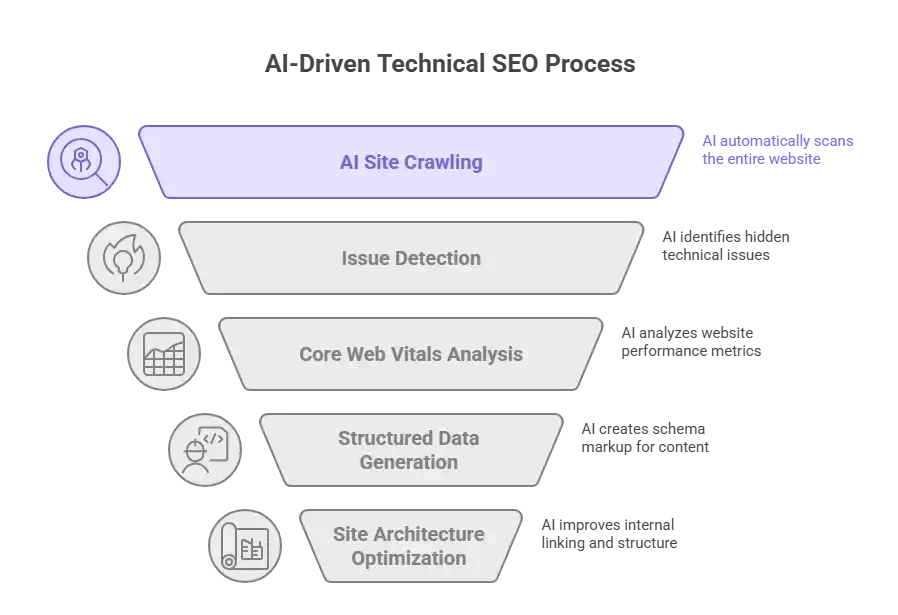
Today, AI-powered technical SEO tools can do the heavy work in seconds. Instead of spending hours digging through reports, AI systems automatically scan your site, detect hidden issues, and help you maintain technical health with far more accuracy. This shift has made AI-powered technical SEO a must for any website that wants to compete.
Here’s what modern AI tools can handle effortlessly:
- crawl your entire website automatically
- Find issues humans often miss
- Analyze Core Web Vitals in detail
- generate structured data and schema markup
- Optimize site architecture and internal linking
- Monitor your site 24/7 with real-time alerts
And here’s the most important part:
AI search engines like ChatGPT, Perplexity, and Gemini rely heavily on clean technical signals. If your site isn’t well optimized, fast, crawlable, structured, and error-free, AI platforms won’t use your content, even if your SEO is strong. This is why mastering AI agents for Technical SEO is no longer optional. It’s the new baseline for staying visible in both traditional and AI-driven search.
How AI Understands Technical SEO Issues (Before You Fix Them)
Before you start using any AI tools, it’s important to understand one thing: AI doesn’t read your website the way humans do. It doesn’t just scan keywords, it evaluates how well your site is built. That’s why mastering AI for Technical SEO begins with understanding how AI systems interpret your pages.
AI looks at the overall health of your site. It checks whether your pages are easy to crawl, well-structured, and technically clean. If your foundation is weak, even perfectly written content won’t rank on Google, and especially not on AI search engines like ChatGPT, Perplexity, or Gemini.
AI systems examine signals like:
- clarity
- clean structure
- crawlability and indexability
- freshness of content
- page experience and speed
- internal linking
- proper markup and schema
If any of these elements are missing, your site becomes harder for AI-driven search to understand or trust. That’s why AI-powered technical SEO tools play such a huge role they help you fix these issues quickly and accurately.
Let’s break down how AI tools handle all of this for you.
1. Automate Site Audits (The Fastest Win)
If you’ve ever done a technical SEO audit manually, you know how exhausting it can be. It takes hours of crawling pages, checking URLs, and fixing issues one by one. And the bigger the website, the harder it gets. This is exactly where AI for Technical SEO makes the entire audit process faster, cleaner, and far more accurate.
This is where AI agents for Technical SEO completely change the workflow. Instead of manually digging through hundreds of pages, AI scans your entire site in minutes and identifies issues instantly.
It flags problems like broken links, missing meta tags, duplicate content, redirect chains, crawlability errors, and slow-loading pages, all without you lifting a finger.
Why it matters:
AI doesn’t just detect issues faster, it catches patterns humans usually miss, especially on large or complex sites. This makes your technical SEO far more accurate, efficient, and consistent.
2. Improve Site Performance (Core Web Vitals Made Simple)
Page speed and Core Web Vitals are now essential for ranking AND for AI visibility.
But diagnosing performance issues manually? Nearly impossible.
That’s because slow pages aren’t caused by just one thing. It could be a heavy image, a script blocking rendering, layout shifts, or even server delays, and tracking all of this by hand takes hours.
AI-powered technical SEO tools change that completely. They analyze your Core Web Vitals in seconds, breaking down issues like LCP, INP, CLS, render-blocking JavaScript, unoptimized images, and slow server responses. More importantly, AI for Technical SEO doesn’t just tell you what’s wrong, it shows you exactly what to fix and how to fix it.
Some examples of the recommendations you’ll get:
- Compress specific oversized images
- preload high-priority assets
- Reduce unnecessary JavaScript
- Shift non-critical scripts below the fold
- enable caching for faster returning visits
With AI, page-speed optimization becomes actionable, precise, and far more effective, giving your site a real advantage in both SEO and AI-driven search platforms.
3. Generate Structured Data Automatically (Schema Without Coding)
Schema markup is essential for helping AI understand your content, but writing it manually can be a nightmare. It’s time-consuming, repetitive, and easy to break if you miss even a small detail.
AI fixes this instantly. Just describe the page or paste a URL, and AI-powered technical SEO tools generate clean, accurate JSON-LD schema for you. No coding, no guesswork, no confusion.
Whether you need FAQ, Product, Article, HowTo, Breadcrumb, or Organization markup, AI creates the right structure every time, helping your pages get indexed faster, interpreted correctly, and featured more often in rich results and AI-generated answers.
That’s why structured data is now a key element of modern AI content optimization.
4. Optimize Site Architecture & Internal Linking
Your internal linking structure is one of the strongest signals for search engines and AI crawlers, but figuring out what to link, where to link, and how much to link can get messy fast. That’s where AI becomes a game-changer.
AI tools can scan your entire site and instantly show you which pages lack internal links, where your topical clusters are weak, where link equity is being wasted, and even which pages Google crawls but shouldn’t. It also identifies missing pillar pages and suggests high-value connections you may have overlooked.
The best part? AI recommends context-relevant internal links based on semantic similarity, something even experienced SEOs struggle to do at scale. Strong internal linking improves crawlability, boosts topical authority, and makes your site far easier for AI systems to understand and use in search results.
It also helps AI search algorithms interpret your site’s hierarchy and content relationships more accurately.
5. Monitor Technical Issues in Real Time
Traditional SEO tools run audits occasionally, but AI tools monitor your site constantly. Instead of waiting days or weeks to discover problems, AI alerts you the moment something breaks, giving you real-time visibility into your site’s health.
AI can notify you instantly if your robots.txt changes, your sitemap breaks, your page speed drops, a page gets deindexed, internal links fail, or JavaScript stops rendering important content. These are issues that can silently damage rankings if not caught early.
With continuous monitoring, AI works like a full technical SEO team watching your website 24/7. You stay ahead of problems, fix issues before they hurt performance, and maintain a consistently optimized site that AI search engines can trust.
6. Fix JavaScript Rendering Issues Automatically
A major challenge many websites face today is that AI crawlers don’t execute JavaScript. That means if your important content loads through client-side JS, AI search engines may completely skip it even if the page looks perfect to a human. This creates silent indexing issues that hurt visibility across AI platforms.
This is why AI for Technical SEO is becoming essential. These tools can scan your pages exactly the way AI systems do and reveal which sections fail to load, which elements remain invisible, and where rendering breaks. They also recommend fixes like server-side rendering or reducing heavy JavaScript, ensuring your content can be crawled and understood properly across AI-driven search platforms.
AI tools can help you by identifying:
- unrendered or missing content
- JavaScript blocking issues
- Elements AI crawlers cannot read
- Pages requiring server-side rendering an important step in AI for Technical SEO
- What Google and AI systems actually see during a crawl
With this clarity, your site becomes fully accessible to both search engines and AI systems, improving technical health and overall visibility.
7. Maintain Clean Sitemaps & robots.txt Files
Your sitemap and robots.txt file are the foundation of your technical SEO they tell search engines and AI crawlers exactly what to access and what to avoid. But maintaining them manually is risky. One wrong line in robots.txt or an outdated sitemap entry can hurt your visibility without you even noticing.
This is where AI tools make a huge difference. They keep these files clean, updated, and error-free by automating the tasks most teams overlook or get wrong.
AI tools can help you:
- auto-generate fresh sitemaps
- remove outdated or dead URLs
- Prioritize your most important pages
- clean unnecessary tracking parameters
- Optimize your robots.txt without breaking anything
With AI-powered technical SEO, you avoid accidental disasters like blocking your whole site or indexing staging pages and keep your crawling signals perfectly optimized.
This consistency strengthens your overall AI SEO optimization and keeps your site fully crawlable.
Key Considerations When Using AI for Technical SEO
AI is incredibly powerful but not a replacement for human expertise.
Keep in mind:
1. Human oversight is still essential
AI gives suggestions. Humans decide strategy.
2. Data accuracy matters
Always verify numbers, logs, and metrics.
3. Avoid scaled, low-quality automation
Google penalizes mass-produced content, even if AI-generated.
4. Technical SEO still needs foundational knowledge
AI speeds up the work, but you must understand what to fix and why
Conclusion
AI is reshaping technical SEO, and doing everything manually is no longer enough. Sites that adopt AI gain speed, accuracy, and stronger technical foundations.
This is why many brands now rely on AI for Technical SEO to stay competitive.
When you combine AI for Technical SEO with your own strategy and judgment, you get the best of both worlds. AI handles the repetitive work, and you focus on what truly improves performance.
From Core Web Vitals to schema, internal links, and real-time monitoring, AI makes technical SEO faster and more scalable. It helps your site stay optimized, visible, and ready for both search engines and AI systems.