You check Google Analytics every day. Traffic looks flat. But AI answers are everywhere, and you cannot see if your brand is even present.
This happens because AI search does not work on clicks anymore. AI models answer users directly. They may mention your brand without sending traffic. So measuring success only through Google Analytics no longer shows the full picture.
Here are 8 clear ways to measure AI visibility properly.
You will learn what to track, which signals matter, and how to understand brand visibility in AI search beyond clicks.
Why Google Analytics Alone No Longer Works
Google Analytics tracks visits, clicks, and sessions.
But AI search often ends before a click happens.
Users get answers directly inside AI tools.
This is where many people feel lost.
Your content may influence decisions.
Your brand may be mentioned.
But analytics stays silent.
That silence does not mean invisibility.
What Google Analytics cannot show
- Brand mentions inside AI answers
- Citations without clicks
- Influence before conversion
- Visibility in zero-click results
Once you accept this gap, measuring AI visibility starts to make sense.
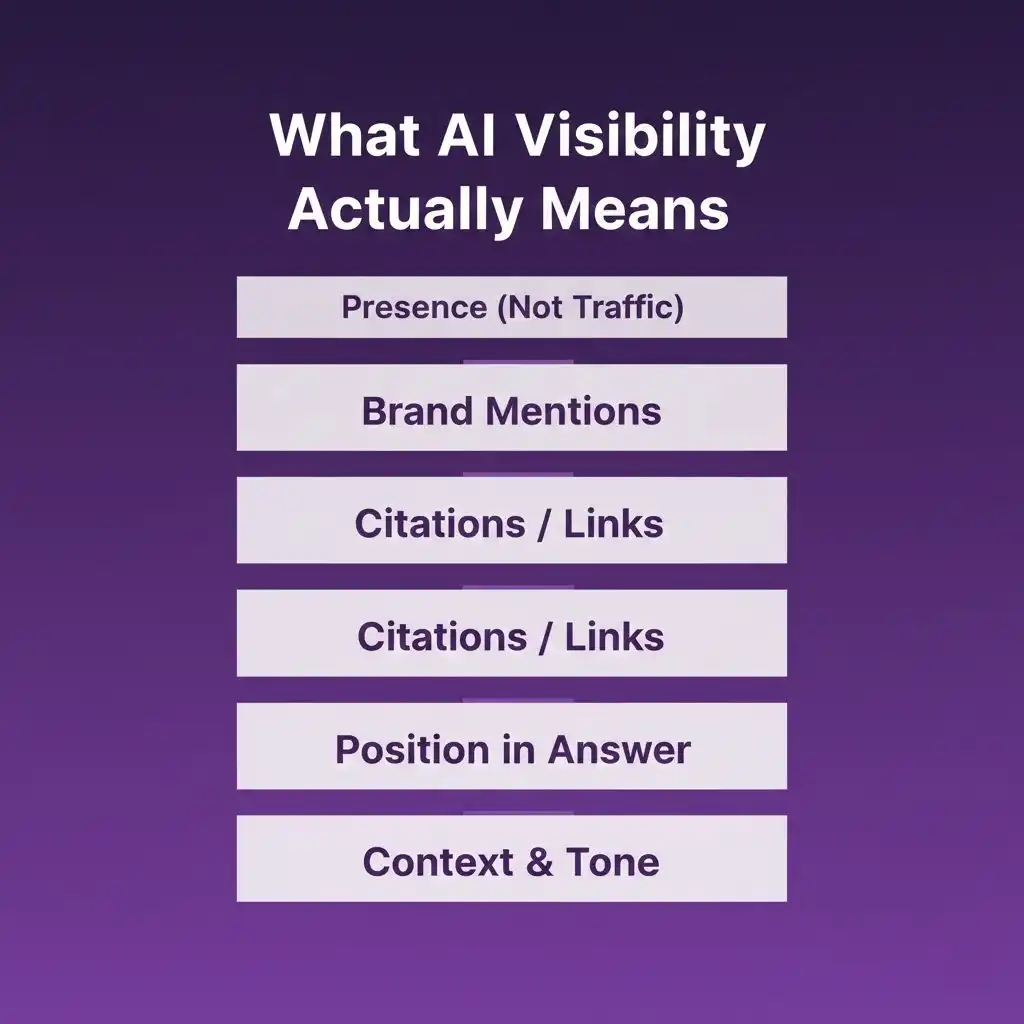
What AI Visibility Actually Means
AI visibility is not about traffic.
It is about presence.
It shows whether AI models know your brand and trust it enough to mention it.
When AI answers questions, it chooses sources.
If your brand appears in those answers, you are visible, even without clicks.
Core elements of AI visibility
- Brand mentions in AI responses
- Citations or source links
- Position inside the answer
- Context and tone
This shift changes how you measure visibility in AI search.
Track Brand Mentions Inside AI Answers
The first step is simple. You start by checking whether AI mentions your brand when users ask relevant questions. These questions should match what real users would naturally ask while searching or deciding.
To do this properly, think from the user’s point of view. Ask yourself what someone would type or say when they are confused, comparing options, or looking for guidance. These are usually simple, clear questions, not technical ones.
For example, users may ask:
“How to measure AI visibility for a brand?”
“Best tools to track brand visibility in AI search”
“How do AI models mention brands?”
“Which companies appear in AI answers for SEO?”
While testing these questions, you do not force keywords.
You let keywords appear naturally inside the question or topic.
This helps you see how AI connects your brand with those terms.
This process feels manual at first, and that is completely normal.
But it gives you something very important, real visibility.
You begin to see not just if AI mentions your brand, but also how AI understands and positions it.
What to observe during checks
- Is your brand mentioned or ignored
- Are competitors mentioned instead
- Is the mention positive or neutral
- Does AI explain your role clearly
This helps measure brand visibility in AI search directly and shows how strong your presence is inside AI answers.
Measure Share of Voice in AI Responses
Share of voice shows how often your brand appears compared to other brands.
In AI search, this becomes even more important because rankings are no longer the main signal.
Instead of tracking positions, you track how frequently your brand is present.
Over time, this helps you clearly understand your market position inside AI models and AI-generated answers.
Signals that show strong AI share
- Your brand appears repeatedly
- Competitors appear less often
- Your name is associated with key topics
- Mentions stay consistent over time
This is a powerful way to measure AI visibility beyond traffic.
Track AI Citations, Not Just Mentions
A mention shows awareness.
A citation shows trust.
When AI links to your content or clearly names it as a source, it signals authority.
These citations matter because they show confidence in your content, even when no click happens.
What citation tracking tells you
- Which pages does AI trusts
- Which topics trigger citations
- Where authority is strongest
- What content needs improvement
This is where AI visibility tools become useful.
Use AI Visibility Tools for Scale
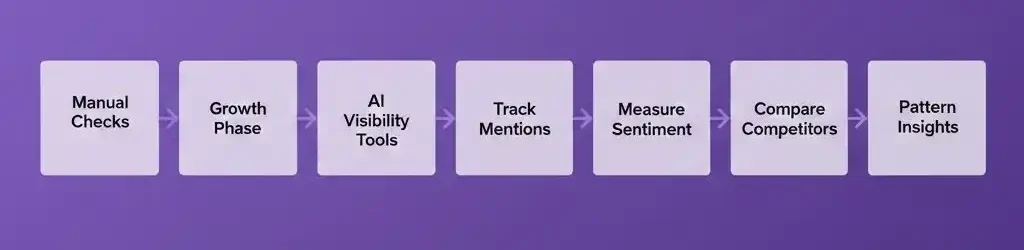
Manual checks work well in the early stage. They help you understand how AI is talking about your brand and what kind of questions trigger mentions. But as things grow, this approach does not scale. This is where AI visibility tools become useful.
Tools like Otterly.ai, Profound, Rankscale, and ZipTie help track brand mentions, citations, and sentiment across AI platforms. Some SEO platforms, like Semrush AI SEO Toolkit, also show brand visibility inside AI Overviews and generative search results.
These tools help you see clear patterns over time.
Instead of guessing, you start understanding where your brand appears, how often it is mentioned, and how AI positions it.
What good AI visibility tools provide
- Brand mention tracking
- Citation frequency
- Sentiment signals
- Comparison with competitors
These tools support long-term measurement without guesswork.
Measure Prominence, Not Just Presence
Being mentioned is good, but being mentioned first matters more in AI-generated answers.
Prominence means where your brand appears inside the response.
To measure this, you check whether your brand shows up at the top, in the middle, or at the end. Brands placed early are easier to remember and are seen as more important by users.
You can measure prominence by asking the same set of questions regularly across AI tools.
Each time, note your brand’s position in the answer.
Is it listed first, grouped with others, or mentioned briefly at the end?
Tracking this over time shows whether your brand is gaining or losing visibility inside AI models.
Signs of strong prominence
- Mentioned early in the answer
- Listed as a main option
- Explained clearly, not briefly
- Repeated across related questions
This adds depth to how you measure visibility.
Track Topic Association and Relevance
AI models connect brands with specific topics and ideas based on how content appears across the web.
If your brand is linked with the wrong topics, AI may mention you in the wrong context.
To track this, observe which topics appear alongside your brand when AI answers related questions.
You can track topic association by asking AI different questions from your niche every month.
Note which themes, industries, or use cases are mentioned with your brand.
If AI repeatedly links you to the same correct topics, your association is strong.
If not, it shows where clarity and content improvement are needed.
What to monitor here
- Topics AI links to your brand
- Missing associations
- Incorrect positioning
- Competitor topic ownership
This enhances the measurement of visibility and accuracy together.
Build a Simple AI Visibility Dashboard
You don’t need complex systems to get started.
It is better to start small and stay consistent.
Track the same prompts every month.
Record brand mentions, citations, tone, and position in the response.
Over time, clear patterns begin to appear.
What a basic dashboard includes
- Prompt list
- Brand mentions
- Citation count
- Sentiment notes
- Trend changes
This replaces click obsession with clarity.
What Changes When You Measure AI Visibility Correctly
You stop guessing.
You stop chasing clicks that never come.
You start seeing influence clearly.
AI visibility shows brand strength before traffic.
It explains why conversions happen later.
It reveals silent wins.
Conclusion
Measuring AI visibility requires a mindset shift.
Clicks are no longer the main signal.
When you track brand mentions, citations, prominence, and topic relevance, you finally see how AI models treat your brand.
That is how you truly measure AI visibility beyond Google Analytics.
Your brand may already be visible.
You just were not measuring it the right way.