
Search is no longer just about finding pages. It’s about receiving answers.
Today, people ask questions inside AI tools, and responses are generated instantly using information pulled from across the web. In many cases, the user never sees the original source, even though that source helped shape the answer.
This change is why understanding what is generative engine optimization is has become important. GEO explains how content stays visible when AI systems decide what to say, not just what to rank.
What Is Generative Engine Optimization (GEO)?
Generative Engine Optimization is about visibility inside AI-generated answers, not just search results.
Instead of focusing only on ranking pages, GEO focuses on making your content usable for AI systems that generate responses. These systems don’t browse like humans. They read, extract, verify, and then respond using selected information.
From a reader’s point of view, GEO helps ensure that when AI explains something, your content is part of that explanation. From a platform’s point of view, it ensures clarity, trust, and relevance.
What GEO Focuses On
- Making content easy for AI to understand
- Answering questions clearly and early
- Structuring information logically
- Building trust signals beyond keywords
- Supporting AI-generated responses
This is why generative engine optimization GEO is not a replacement for SEO, but an evolution of it.
Understanding this definition helps you stop treating AI visibility as a mystery.
Why GEO Became Necessary in the First Place
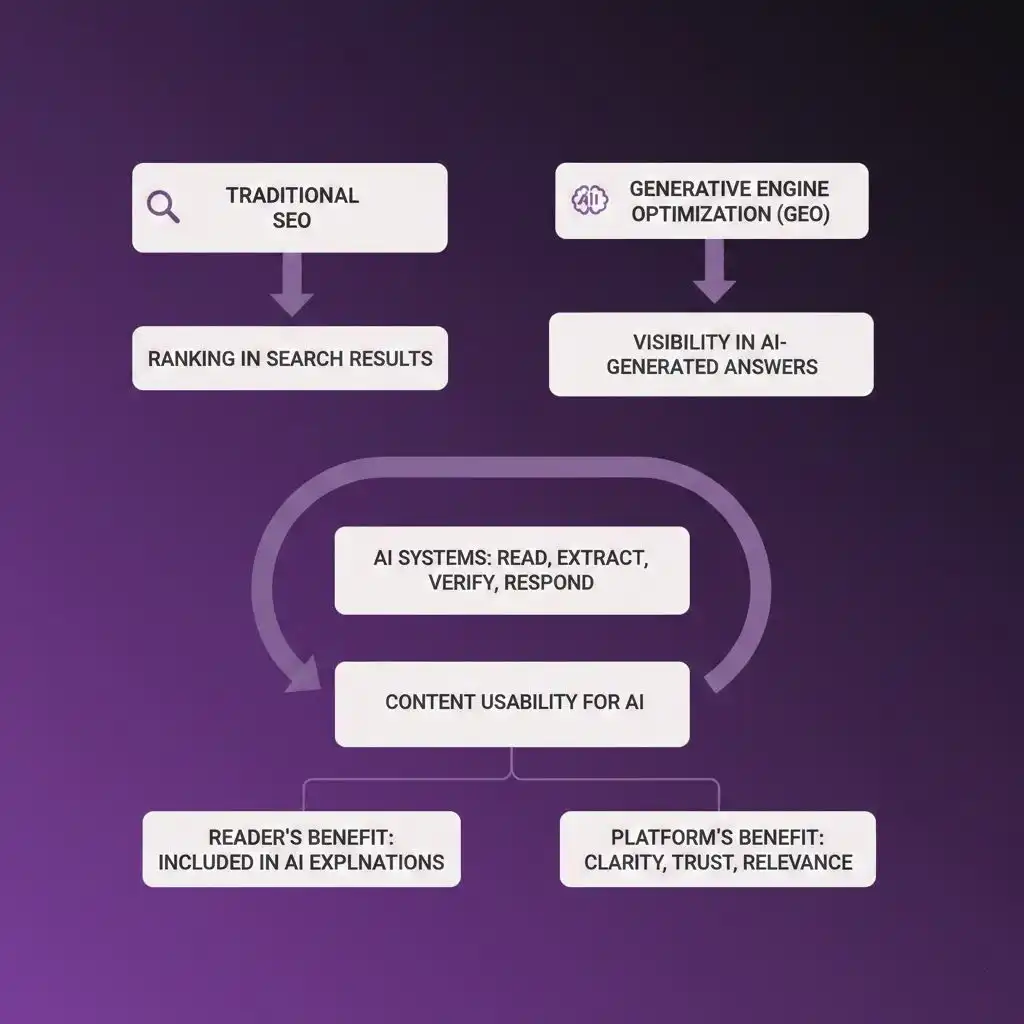
Traditional search rewarded pages that ranked well.
Generative search rewards content that can explain well. AI systems don’t show ten blue links. They usually show one answer. That change reduces the available space for visibility and increases competition.
When answers are generated instead of browsed, only content that feels reliable and complete gets selected. This is where many SEO-only pages quietly disappear from visibility.
What Changed in Search
- Answers appear before links
- Fewer sources get cited
- Clicks are no longer guaranteed
- Visibility depends on clarity, not position
GEO exists because search behavior changed, not because SEO failed.
This section helps beginners understand why old tactics alone feel insufficient.
How Generative Engine Optimization Works
GEO works by aligning content with how AI systems process information.
Unlike classic search engines, large language models do not sort websites by position or ranking. They scan information, break it into parts, compare it with known data, and then decide what is safe and useful to reuse.
Content that feels scattered or vague is harder to trust. Content that explains one idea at a time becomes easier to extract.
How AI Uses Your Content
- Identifies the main question
- Finds direct explanations
- Checks consistency with other sources
- Selects content that can be safely repeat
This process is closely connected to LLM optimization, where content is written for understanding, not just indexing.
Once you understand this flow, GEO stops feeling abstract.
GEO vs Traditional SEO: What’s Actually Different
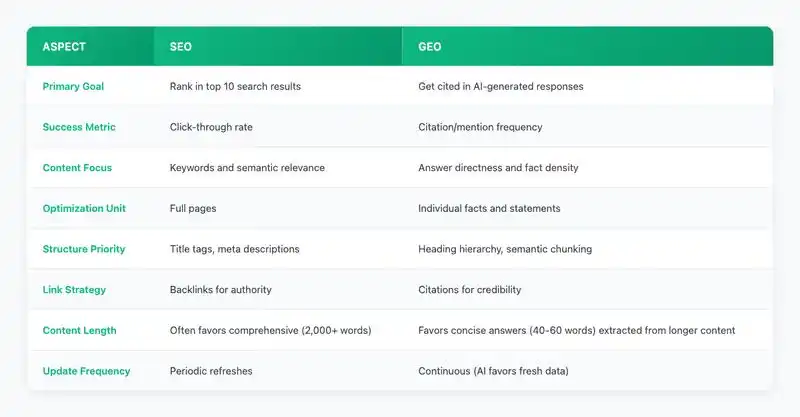
SEO focuses on ranking pages. GEO focuses on selecting answers.
SEO helps users find content. GEO helps AI use content. Both matter, but they solve different problems.
SEO still brings traffic. GEO supports visibility when traffic is no longer guaranteed.
Key Differences Between GEO and SEO
- SEO optimizes for search engines
- GEO optimizes for AI responses
- SEO measures clicks and rankings
- GEO measures mentions and visibility
This is why people often describe GEO SEO as complementary, not competitive.
This comparison helps professionals reposition their strategy instead of replacing it.
Why Limited Citation Space Changes Everything
In traditional search, many pages could rank.
In generative answers, only a few sources are referenced. This makes competition tighter and clarity more important. AI systems prefer sources that explain concepts cleanly and confidently.
If content needs heavy interpretation, it’s less likely to be selected.
What Limited Space Means
- Fewer brands get visibility
- Generic content is filtered out
- Authority matters more than volume
- Clear explanations win
GEO helps content compete in this limited environment without chasing shortcuts.
This section explains why quality suddenly matters more than scale.
How Content Needs to Change for GEO
Content written only for humans often assumes patience.
AI systems assume efficiency. They look for answers that stand on their own. This is why structure, summaries, and direct explanations become more important.
Writing doesn’t need to become robotic. It needs to become clearer.
Content That Works Better for GEO
- Clear headings
- Direct answers near the top
- Simple, factual language
- One idea per section
These principles align naturally with generative engine optimization without forcing unnatural formatting.
This section helps writers adapt without losing their voice.
The Role of Trust and Authority in GEO
AI systems avoid uncertainty.
They prefer content that feels consistent with known facts and trusted sources. Authority is built over time, not declared. Mentions, consistency, and accuracy all contribute.
This is where brand presence matters, even outside your website.
Trust Signals AI Notices
- Consistent information
- Recognisable entities
- Reliable references
- Clear authorship
GEO benefits from the same trust foundations that SEO values, but applies them more strictly.
This section explains why shortcuts rarely work.
How Beginners Should Start with GEO
You don’t need advanced tools to begin.
Start by making your content clearer, more focused, and easier to understand. Answer real questions. Avoid filler. Structure information logically.
These basics already align with GEO SEO principles.
Beginner-Friendly GEO Steps
- Answer before explaining
- Simplify complex ideas
- Organise content cleanly
- Update outdated information
Small changes often create meaningful visibility improvements.
This section reduces overwhelm for new learners.
How Professionals Can Advance Their GEO Strategy
At an advanced level, GEO becomes about consistency and depth.
Professionals focus on topic authority, connected content, and long-term trust. Instead of optimising pages in isolation, they build ecosystems of understanding.
Pro-Level GEO Focus Areas
- Topic clusters
- Entity consistency
- Cross-platform mentions
- Strategic content updates
This is where LLM optimization supports scalable visibility.
This section helps experienced marketers level up without hype.
Measuring Success with Generative Engine Optimization
Clicks are no longer the only signal.
Success includes impressions, recognition, and influence. When AI uses your content to answer questions, visibility still exists, even if traffic looks lower.
Understanding this prevents wrong conclusions.
What to Look At Instead
- Impression trends
- Brand searches
- Returning users
- Assisted conversions
GEO success often appears indirectly before it appears in analytics.
This section reframes expectations clearly.
Final Thoughts
Generative Engine Optimization exists because search learned how to answer.
When people ask what is generative engine optimization is, the real answer is simple: it’s about helping your content stay useful in an AI-driven world.
SEO still matters. But GEO ensures your knowledge remains visible even when users stop clicking. And that balance is what defines modern search success.