Do you ever think about how AI is changing SEO and what that means for you going forward?
It’s a common question today, and it’s exactly why so many people ask, “Will AI Replace SEO?” as we move into 2026. AI tools are getting faster and smarter, and that naturally makes you wonder where your skills, your content, and your business fit in.
But the truth is simple: SEO isn’t disappearing. It’s shifting into a more AI-driven world where human judgment, clarity, and experience still matter just as much. If you want to stay visible in the AI era, understanding this new balance is the real advantage.
Will AI Replace SEO in 2026?
No – AI will not replace SEO. But it will change the way SEO works.
AI can handle the repetitive tasks you don’t want to spend hours on, like keyword grouping, metadata, outlines, and quick SERP analysis. But it still can’t replace the parts that actually make your content valuable: understanding what people really want, adding real experience, and shaping a message that builds trust.
That’s why the future of SEO is a mix of both.
AI gives you speed and scale, while you bring clarity, insight, and human judgment. When these two work together, you create the kind of content search engines and real users respond to.
This balance is exactly what matters most in the AI era.
Why This Question Is More Common in 2026
Many people ask Will AI Replace SEO because search is changing on every level, and it’s happening fast. Search engines behave differently, users interact differently, and AI is now tightly woven into how answers are delivered. With so much shifting at the same time, it’s natural to wonder what the future looks like for you and your business.
One of the biggest changes is the rise of AI Overviews. Google now gives full, ready-made answers at the top of the results, which means a lot of searches end without any clicks. Your visibility depends on being cited inside these AI responses, not just ranking on traditional blue links.
User behavior has changed, too. People search in more natural ways and expect quick clarity. Today, users:
- ask conversational questions
- use voice, visuals, and screenshots
- prefer short summaries over long searches
- want instant answers without clicking
Meanwhile, Google’s algorithms like RankBrain, BERT, and MUM focus more on understanding intent than matching keywords. They read context, tone, and meaning to figure out what the user truly wants.
That’s why keyword-heavy content doesn’t work anymore. In the future of SEO, clear, structured, intent-first content is what helps you stay visible both to users and to AI systems.
How AI Is Changing SEO in 2026
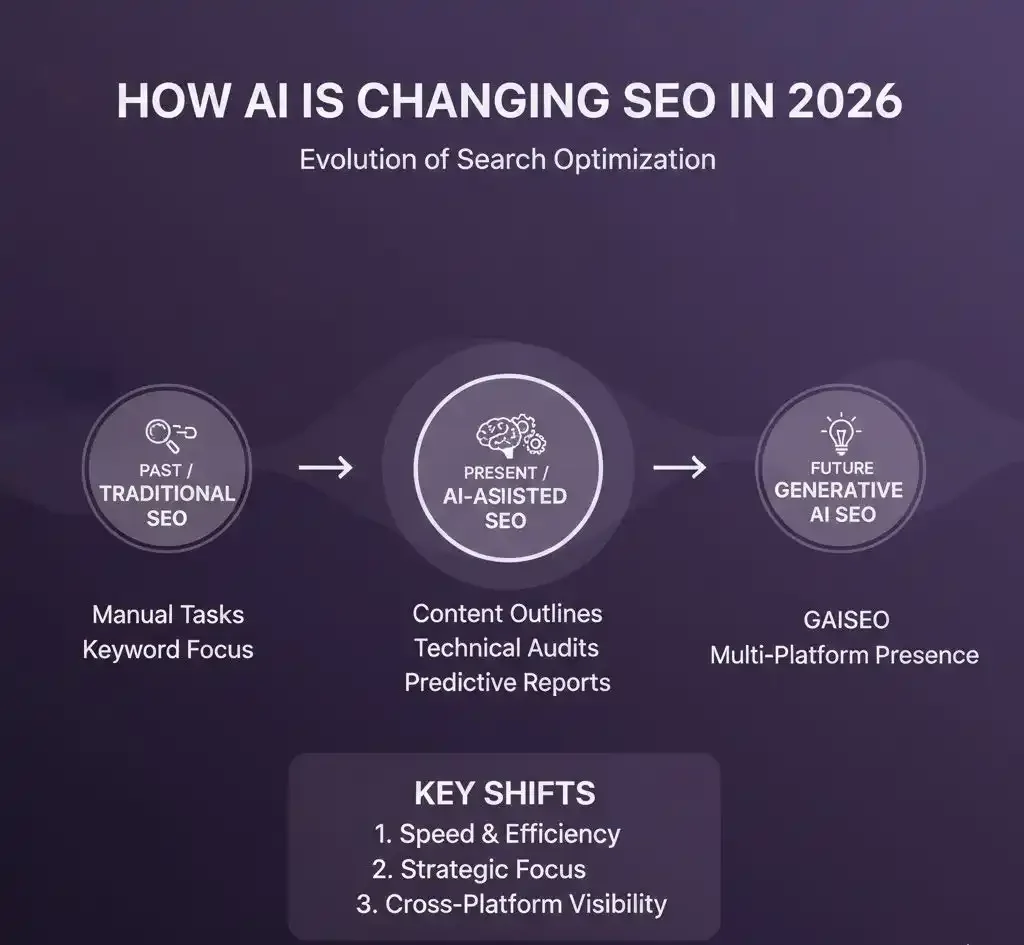
AI isn’t killing SEO, it’s shaping a newer, smarter version of it. The changes you’re seeing today aren’t about replacing your role, but about giving you faster tools and clearer insights so you can focus on what actually matters.
Content creation is now faster and more structured.
AI tools handle outlines, research, and first drafts in minutes. Instead of starting from a blank page, you get a strong base that you refine with your own expertise, examples, and real experience. This blend of speed and human insight is becoming a big part of the future of SEO.
Technical SEO has become much more efficient.
AI can spot crawl issues, suggest schema, and highlight technical gaps automatically. That means you spend less time fixing small issues and more time thinking about strategy, user experience, and long-term growth.
Reporting is smarter and more predictive.
Instead of waiting for monthly drops or sudden ranking changes, AI tools surface patterns in real time. You can see shifts in user behavior, early ranking dips, or rising opportunities long before they become problems.
Generative AI SEO (GAISEO) is growing quickly.
Brands are now shaping content specifically for AI-generated visibility using clear answers, structured summaries, and simple sections that AI can understand and cite easily. It’s a natural evolution of SEO in the AI era.
Visibility is no longer limited to Google alone.
To stay present in 2026, your content needs to appear across multiple AI-driven surfaces, including:
- AI Overviews
- People Also Ask
- Featured Snippets
- Gemini and ChatGPT answers
- Bing Copilot summaries
SEO now spans a wider landscape, and showing up across these touchpoints is becoming just as important as traditional rankings.
The Future of Search in 2026
Search is moving toward deeper, more intuitive experiences, where AI plays a major role in how information is delivered and understood.
AI Overviews have become the default answer layer.
Google now pulls insights from multiple sources and presents a complete explanation instantly. Traditional rankings still help, but being cited inside these AI answers matters even more in the future of SEO.
Intent-first search is now the foundation.
Search engines understand natural language, context, and meaning. Content needs to genuinely solve a user’s question, not just repeat keywords, if you want to stay visible in the AI era.
Search is increasingly multimodal and conversational.
People search through voice, images, screenshots, and follow-up questions. Your content has to match how real users think, ask, and interact, not how we used to optimize pages years ago.
Results are far more personalized.
Two users can search the same phrase and see completely different results based on their history, preferences, and intent. The goal isn’t just broad ranking anymore, it’s showing up where each user needs you most.
This is the real direction of SEO in 2026: a mix of AI-driven understanding and human-built trust working together.
What Businesses Should Do Right Now
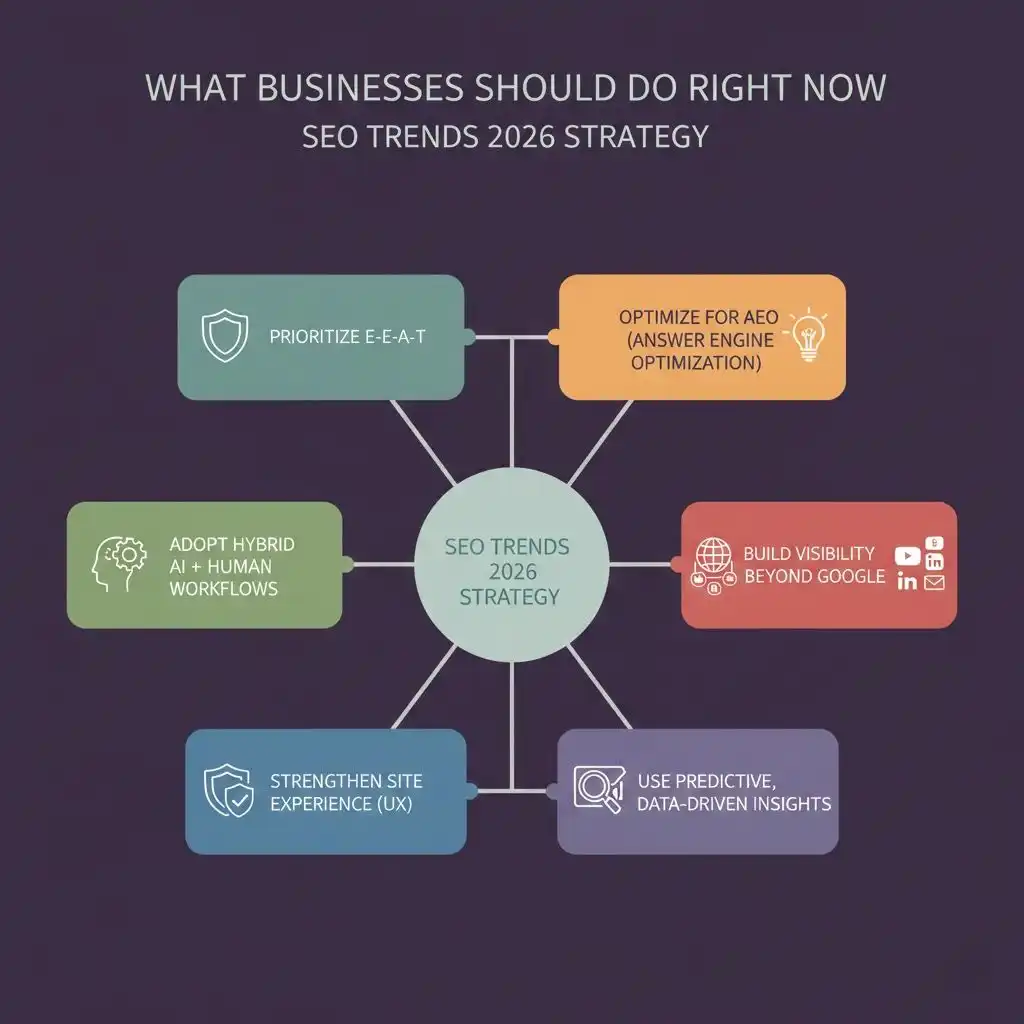
To stay ahead of SEO trends 2026, your strategy needs a balanced approach.
1. Prioritize E-E-A-T across every platform
Show expertise, experience, authority, and trust. AI can’t replicate your lived insights or original perspectives.
2. Adopt hybrid AI + human workflows
AI speeds up research and structuring. Humans refine tone, intent, accuracy, and brand story.
3. Optimize for AEO (Answer Engine Optimization)
Use answer-first paragraphs, clear headings, concise summaries, FAQ sections, and schema markup.
This makes your content easy for AI to extract and cite.
4. Build visibility beyond Google
Repurpose content for YouTube, LinkedIn, newsletters, communities, and short-form platforms. AI tools pull context from everywhere.
5. Strengthen site experience (UX)
Fast, intuitive, accessible websites perform best in AI-driven ranking systems.
6. Use predictive, data-driven insights
AI tools help identify content decay, new opportunities, and upcoming trends, enabling faster decisions.
Conclusion
AI will not replace SEO in 2026, but it will continue to reshape how search works.
The strongest brands will be the ones that combine AI’s speed with human depth, clarity, and authenticity. When your content is structured clearly, answers real questions, and carries genuine expertise, you stay visible across every AI-powered search experience.
In the AI era, you’re not just competing for clicks.
You’re competing to be the most trusted and most visible answer wherever your audience searches.