Ever searched for something and realized you already got your answer without clicking anything? That’s zero-click search, and it’s becoming even more common as we move into 2026.
AI is getting faster, smarter, and more confident with the way it delivers information. Google, Gemini, ChatGPT, Bing Copilot, all of them now give full answers directly on the results page. Users don’t open links unless they really need more depth. And that simple shift is changing how visibility works for every business, creator, and marketer.
This is why understanding zero-click searches matters so much today. If people aren’t clicking, you need to make sure your content is still being seen, cited, and trusted inside AI-generated answers. Because in 2026, search isn’t just about ranking, it’s about showing up where the user sees the answer first.
Once you understand how zero-click results work and how AI search optimization fits into this new reality, you can still stay visible… even when the click never happens.
How to Optimize for Zero-Click Searches in 2026 (AI Search Optimization)
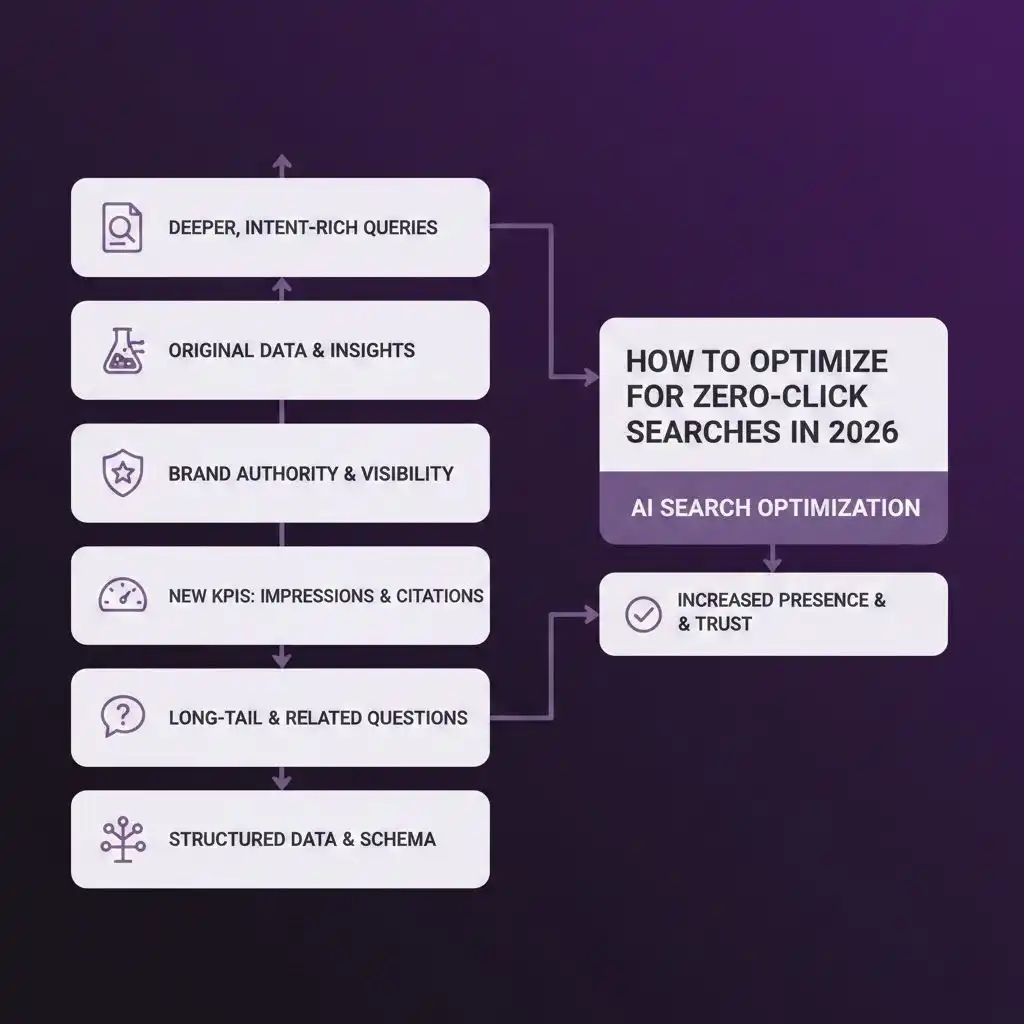
Search in 2026 is all about being present, where the user gets their answer. You’re not just competing for clicks anymore, you’re competing for presence inside AI summaries, PAA sections, and zero-click results.
Here’s how to build visibility in a world where users rarely click but still notice the brands that show up consistently.
1. Focus on deeper, intent-rich queries
Search engines instantly answer top-of-funnel questions, so competing for them gives you almost no return. In 2026, the real opportunity lies in mid- and bottom-funnel search queries that AI cannot summarize in a single line.
These are queries where users want guidance, steps, comparisons, or expert insight, the kind of depth that AI Overviews often draw on.
Why this works for zero-click searches:
- Less zero-click competition
- Higher conversion intent
- More chances to appear in AI summaries
- Better topic authority over time
By focusing on deeper questions, your content becomes harder for AI to replace and easier for users to trust.
2. Use original data, case studies, and expert insights
In a world filled with generic AI content, original insights are becoming the strongest ranking signal. Search engines and AI models prefer sources that provide something new, not just rephrased information already available across the web.
Add your own:
- customer data
- experiments
- personal experiences
- mini case studies
These elements make your content credible and more likely to be cited inside zero-click results, AI Overviews, and conversational search responses.
3. Build brand authority and visibility
Even if users don’t click, your brand can still show up repeatedly, and that matters more than ever in 2026.
When people see your business inside snippets, AI Overviews, and PAA responses, you build subconscious trust long before they ever visit your site.
To strengthen brand visibility:
- maintain a consistent tone
- publish regularly across platforms
- Use social proof and expert commentary
- appear in clusters of related search queries
Zero-click visibility builds recognition, and recognition builds conversions later.
4. Adapt your KPIs beyond traditional clicks
SEO in 2026 can’t be judged by traffic alone. With zero-click searches rising, CTR will naturally drop even when your pages rank well. If you focus only on visits, you’ll miss how much visibility and trust your content is earning through impressions, AI citations, and SERP presence.
Track metrics that reflect real visibility:
- impressions
- SERP presence
- featured snippet positioning
- AI Overview citations
- branded search growth
- scroll depth and engagement
These signals show whether your content is seen and trusted even when users don’t click.
5. Answer a wide set of long-tail and related questions
Long-tail queries now trigger zero-click searches more often than before. Users ask very specific, natural questions, and AI search systems break them into smaller sub-questions, each one showing its own quick answer, snippet, or PAA result. This makes long-tail optimization essential for visibility in 2026.
To capture multiple placements on the same SERP:
- use question-based H2s and H3s
- include a short FAQ section
- Create cluster blogs around related topics
This makes your content eligible for multiple zero-click results at once, increasing visibility without relying on a single keyword.
6. Implement structured data and schema markup
AI search systems rely heavily on clear structure. When you use schema markup, you help search engines understand your content faster and pull the right details for AI answers, snippets, and rich results. It makes your page easier to interpret and more likely to appear in zero-click results.
Useful schema types in 2026 include:
- FAQ schema
- How-To schema
- Article schema
- Review schema
- Product schema
Schema gives AI the confidence to pull your content into zero-click searches 2026, boosting your chances of being featured even without a direct click.
Conclusion
Zero-click searches may feel like a loss at first, but they’re actually a new form of visibility. In 2026, users get answers instantly, but they still notice the brands behind those answers. If your content is structured well, backed by insights, and easy for AI to extract, you can dominate AI search optimization and stay visible across the entire SERP.
You’re no longer competing only for clicks.
You’re competing for presence, trust, and recognition right where users make decisions.