AI tools have completely changed how we create content, making the process much faster and easier. However, one question frequently comes up: Can AI-generated content rank on search engines? Whether you’re using Google, Bing, DuckDuckGo, Brave Search, or AI-powered search platforms like Perplexity or ChatGPT search extensions, many people are curious about whether AI content can truly compete with human-written material.
The short answer is: Yes, AI content can rank on search engines-but only if it is useful, accurate, and optimized with human oversight.
Let’s break this down simply and clearly.
How Search Engines Treat AI Content
Search engines do not rank content based on who wrote it. They focus on how helpful and relevant the content is for users. This means they don’t automatically penalize AI writing. Instead, they look for the following key factors:
- Content usefulness
- Originality
- Search intent
- Accuracy
- User engagement
- Experience and expertise
These principles apply to all major search engines, not just one.
So, when people ask whether AI content can rank on search engines, the answer often comes down to its quality.
Do Search Engines Penalize AI?
A common misconception is that search engines automatically penalize AI-generated content. This is not true. Search engines focus on content quality, not the writer’s identity. They actually look for the following:
1. Avoiding spammy publishing
If a site suddenly releases hundreds of AI-generated posts quickly, it can look mass-produced and low-quality, leading to demotion.
2. Evaluating content quality
AI can sometimes create repetitive, generic, outdated, or surface-level content that rarely ranks because it does not add real value.
3. E-E-A-T standards
Major search engines like Google, Bing, DuckDuckGo, and Brave Search use E-E-A-T (Experience, Expertise, Authoritativeness, Trustworthiness) to determine credibility. AI alone cannot provide these attributes. Human insight, real examples, and fact-checking are essential for making AI content trustworthy.
So the real question isn’t “Does Google rank AI content?” It’s: Does your AI content actually help the user?
Can AI Content Actually Rank?
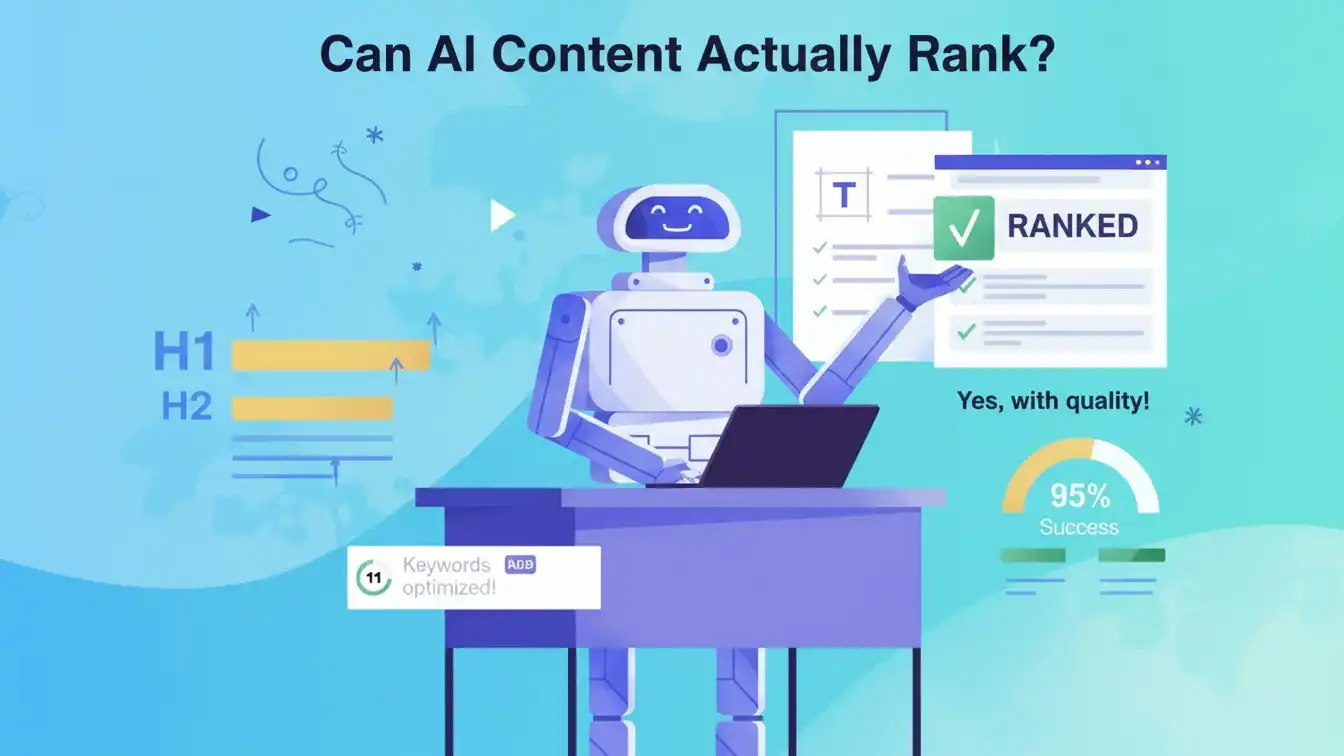
Yes, and it already does. Many top-ranking articles on different search engines show strong signs of being assisted or even fully written by AI. Platforms like Bing, Brave Search, and AI-powered search engines even favor structured, clear information, which AI can produce effectively when guided correctly.
So, can AI content rank on a search engine? Absolutely, when optimized properly.
Factors That Help AI Content Rank
To understand how AI-written content performs on search engines, you need to know what they reward:
1. Matching search intent
If users want a quick explanation, avoid giving them a long technical breakdown.
If they want a comparison, don’t provide a definition.
AI needs human input to ensure the content truly matches what the searcher wants.
2. Clear structure
Search engines prefer:
- Clean headings
- Organized sections
- Bullet points
- Easy readability
This helps the algorithm understand and rank the content more effectively.
3. Human-added insights
AI alone cannot provide:
- Real examples
- Personal experience
- Industry opinions
These elements help build trust and make the content more credible.
4. Factual accuracy
AI sometimes generates outdated or incorrect information.
Search engines detect misinformation quickly, so always fact-check stats, claims, and data before publishing.
Examples: When AI Content Ranks
Here’s a simple example of how AI content can rank:
A small business owner publishes a blog using AI, but then adds:
- Real examples
- Basic SEO
- A clear structure
- Content that matches user intent
Within weeks, the article starts ranking on Google, Bing, and Brave Search because it is reliable, helpful, and easy to read.
This proves that the question “Does AI content rank?” has a clear answer: Yes, when done correctly.
How to Make AI Content Rank Better
If you want your AI content to rank on search engines, consider these key steps:
1. Add human oversight
While AI can draft quickly, your edits bring clarity, accuracy, and personality.
A quick review and refinement can transform basic AI output into content that ranks well.
2. Follow on-page SEO
Use relevant keywords naturally, such as:
- Does Google rank AI content
- Does AI content rank on search engines
- Can AI content rank on a search engine
Add internal links, write a strong introduction, and keep paragraphs short.
3. Update regularly
Search engines reward fresh content.
Adding updates, new insights, or improved formatting can boost rankings over time.
4. Choose the right tools
Not all AI tools are designed for SEO.
Use AI tools that support structured formatting, keyword placement, and content optimization.
Conclusion
In the end, it doesn’t matter whether your content is written by AI or a human search engines care about one thing: value. If your AI content is helpful, accurate, and well-structured, it can rank on any platform from Google to Bing to DuckDuckGo.
AI speeds up the writing, but your strategy and human judgment shape the final quality. When you add clarity, fact-checking, and real insights, the content becomes stronger and more trustworthy.
Combine both, and you get content that doesn’t just exist online, it performs, ranks, and lasts. That’s the real answer to the question: Does AI content rank on search engines?