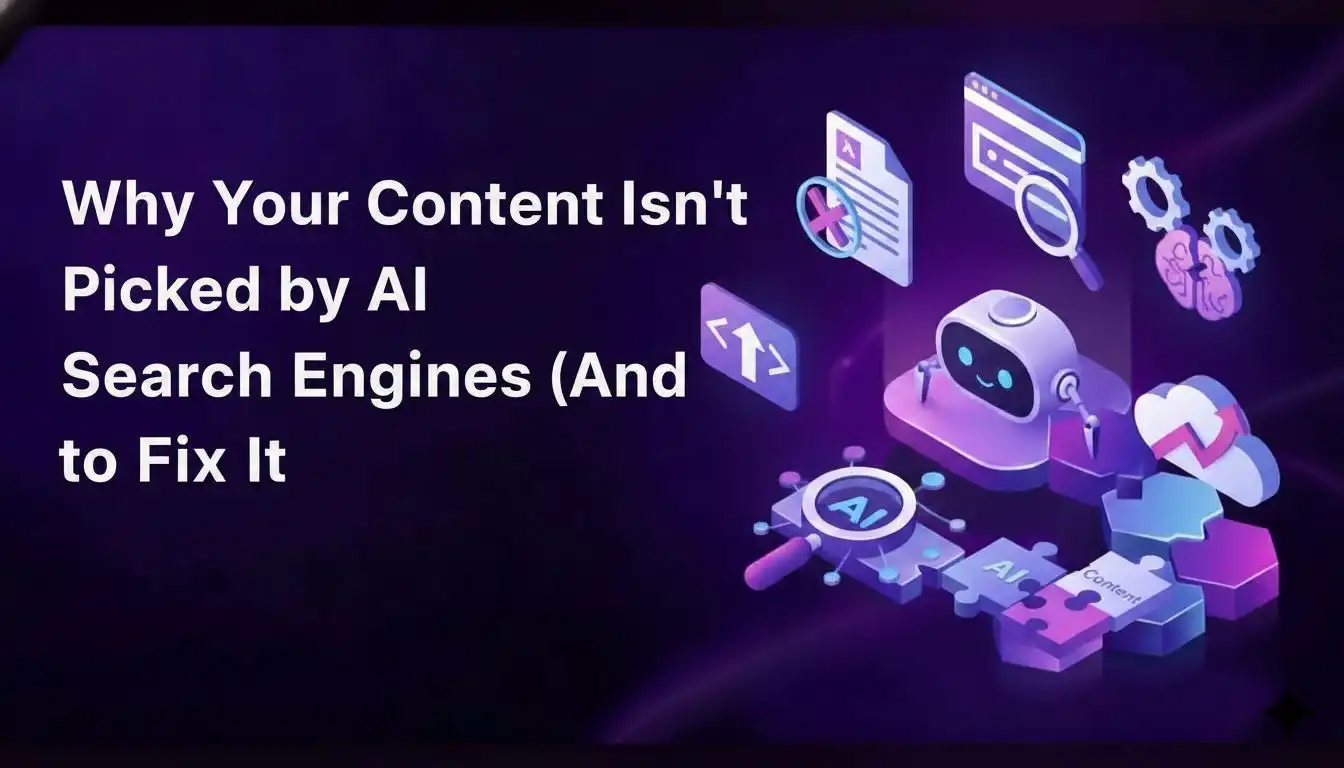
Have you noticed that your content ranks well, yet AI Search Engines never show or cite it?
You publish good work, but AI answers still skip your pages.
This usually happens because AI Search Engines read content very differently from humans.
They do not wait, click, or explore.
They scan fast.
If your content is hard to read for machines, it quietly disappears, even if it is useful.
Here are 8 clear reasons why AI Search Engines ignore content, and simple fixes for each.
You will understand what AI sees, what it skips, and how to make your content easier to pick.
How AI Search Engines Actually Read Your Content
AI Search Engines do not browse your page as a person does.
They do not scroll, click tabs, or open sliders.
They arrive, scan what loads first, and decide quickly if your page is useful enough to summarize or cite.
This is where many people feel confused.
Your page looks perfect to you.
But to AI, large parts of it may not exist at all.
Understanding this gap is the first step toward AI search optimization that actually works.
What most reference guides miss here
- AI reads raw HTML, not visual layout
- Content inside sliders or tabs is often skipped
- Delayed loading content is treated as missing
- AI prefers simple, fast, visible answers
- Design quality does not equal AI clarity
When this becomes clear, you stop blaming your content quality and start fixing visibility instead.
Poor Content Structure Blocks AI Understanding
When content has no clear shape, AI Search Engines struggle to understand what the page is about.
Large text blocks, mixed topics, and weak headings slow AI down.
So the system moves on to pages that explain things faster.
You may feel your writing is detailed and thoughtful.
But AI prefers content that explains ideas in small, clear chunks.
This is why structure matters more than length in AI search optimization.
What usually goes wrong with structure
- No clear H1 explaining the page’s purpose
- Headings that sound creative but unclear
- Long paragraphs with multiple ideas mixed
- Missing lists where clarity is needed
Once the structure improves, AI comprehension improves naturally, without adding more words.
Your Main Answer Appears Too Late for AI
AI Search Engines prefer pages that answer the main question quickly.
If your explanation starts after long intros, banners, or stories, AI may never reach it.
This often feels unfair.
You wanted to guide the reader slowly.
But AI is not patient.
It looks for fast confirmation that your page is worth using.
Why does this delay AI citations
- The key answer is buried deep
- Pages focus on context before clarity
- AI cannot detect priority easily
When you place a clear answer early, AI search optimization becomes much easier.
JavaScript and Interactive Design: Hide Your Best Content
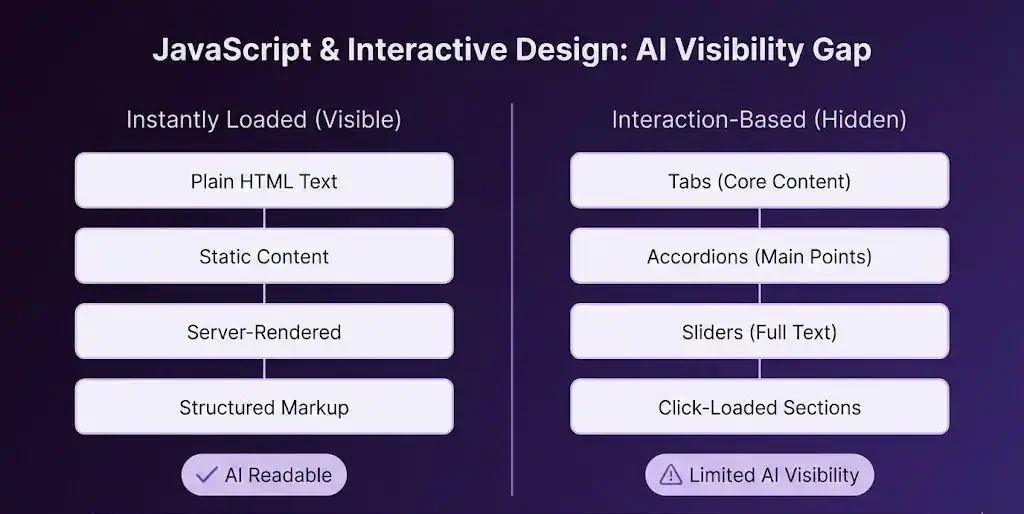
Interactive features feel modern and engaging.
But many AI Search Engines cannot read content that loads only after user actions.
So your best explanations stay hidden.
You may not realize this because everything works fine in your browser.
But AI only sees what loads instantly.
If content depends on clicks, it often disappears from AI view.
Common hidden-content mistakes
- Tabs hiding core explanations
- Accordions used for main points
- Sliders replacing full text
- Content loaded after interaction
Once an important text moves into plain HTML, AI visibility improves fast.
Missing Authority Signals Reduce Trust
AI Search Engines look for trust before they cite.
If your page does not show who wrote it, why they know the topic, or where facts come from, AI hesitates.
This does not mean you need to sound academic.
It simply means clarity about expertise matters.
Authority helps AI decide if your content is safe to share.
Authority gaps AI often notices
- No author information
- No experience context
- No clear ownership of ideas
- No source references
When trust becomes visible, AI citations SEO improves without promotion.
No Structured Data Confuses AI Systems
Structured data works like labels for AI.
Without it, AI must guess what your content means.
When guessing feels risky, AI skips the page.
A schema helps AI understand relationships, questions, and answers clearly.
This supports both AI search optimization and llm content optimization.
What structured data adds
- Clear topic classification
- Question–answer clarity
- Entity recognition
- Easier summarization
Once added, AI systems process your page with less effort.
Older Content Loses Priority in AI Answers
AI Search Engines strongly prefer recent content.
Even good pages lose visibility if they feel outdated.
This often surprises site owners.
You may still get human traffic.
But AI answers quietly shift to newer sources.
Freshness signals matter more in AI search than traditional rankings.
Freshness signals AI looks for
- Recent update dates
- Current examples
- Updated explanations
- Relevant timelines
Small updates can restore AI visibility quickly.
Your Content Is Not Easy to Summarize
AI Search Engines summarize before they cite.
If your content cannot be reduced to clear ideas, AI moves on.
This happens when explanations are vague, repetitive, or scattered.
AI prefers content that naturally turns into short answers.
Signs summarization fails
- Ideas repeat without clarity
- No clear definitions
- Too many metaphors
- No logical flow
When summarization becomes easy, AI selection follows.
How to Fix AI Visibility Without Overthinking
You do not need a full rebuild.
Small, focused changes improve AI search optimization quickly.
Start by making your content easier to read for machines, without harming human experience.
This balance is where AI citations seo grows naturally.
Simple fixes that work
- Place a clear answer under H1
- Use direct, simple headings
- Keep key content visible in HTML
- Add basic schema
- Update important pages
Each step reduces AI confusion and increases trust.
What Changes Once AI Can Read You Properly
You may notice your content appearing in AI summaries.
Your ideas start showing up in answers.
Competitors stop replacing you in AI explanations.
This does not happen overnight.
But once structure, clarity, and trust align, AI Search Engines begin recognizing your content as usable.
Conclusion: Make It Easy, Not Fancy
AI Search Engines do not reward clever design or hidden depth.
They reward clarity, speed, and trust.
When your content is easy to read, easy to summarize, and easy to trust, AI starts choosing it naturally.
That is how llm content optimization and AI search optimization quietly work together.
If your content feels invisible today, it is usually not broken.
It is just hidden.
And now, you know exactly how to fix that.