Have you noticed that even after ranking well, your content is getting fewer clicks than before?
This is not a small fluctuation. Traditional SEO is slowly losing its power because search itself has changed. People are no longer clicking links the way they used to. AI systems now answer questions directly. This shift is affecting traffic, visibility, and trust across almost every industry.
In this blog, you’ll understand why traditional SEO fails in the AI era, how zero-click searches changed user behaviour, and what this means for brands trying to stay visible in AI-driven search environments.
How Search Worked Before the AI Era
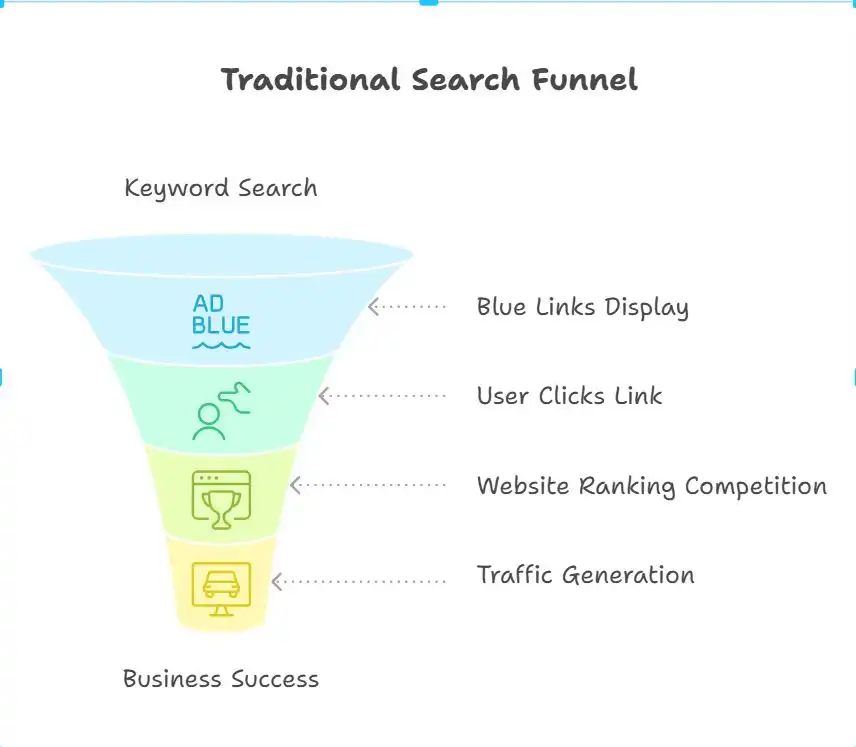
For a long time, the search was simple. You searched for a keyword. Google showed ten blue links. You clicked one. Websites competed to rank higher because ranking meant traffic. Traffic meant business. Traditional SEO was built around this flow.
As a marketer or business owner, you focus on keywords, backlinks, and rankings. If you reached page one, you felt safe. If you reached position one, you felt successful. This system worked because users had no other choice but to click.
But this system depended on one thing.
Users needed websites to get answers.
That dependency is now breaking.
What Changed With AI-Powered Search
Today, search does not always send users to websites. AI-powered systems like Google AI Overviews, ChatGPT, Perplexity, and Gemini often give full answers directly on the screen.
When this happens, users stop clicking.
They stop browsing.
They stop comparing ten links.
This is where traditional SEO in the AI era starts failing. Not because SEO is “dead,” but because it was designed for a very different search behaviour.
You are no longer competing only with other websites.
You are competing with the answer itself.
The Rise of Zero-Click Searches
Zero-click searches mean the user gets what they need without clicking any website. This is now normal behaviour, not an exception.
You may already be seeing this.
Impressions look fine.
Rankings look stable.
But traffic keeps dropping.
This happens because AI summaries sit above your link. Users read them and move on. Traditional SEO measures success through clicks, but clicks are no longer guaranteed.
Why zero-click searches hurt traditional SEO
- Ranking no longer means visibility
- Traffic drops even when positions stay the same
- Content helps AI, but not your website
- Success metrics stop matching reality
Traditional SEO in the zero-click era fails because it was never built to work without clicks.
Why Ranking #1 No Longer Feels Like Winning
Earlier, ranking first meant attention.
Now, ranking first often means being invisible.
AI systems pull information from multiple sources and show a combined answer. Your page might be “used” by the AI but never visited by the user.
From your side, it feels confusing.
Your content works.
But the results don’t show it.
This creates a silent gap between effort and reward. Traditional SEO does not account for this gap because it tracks rankings, not influence.
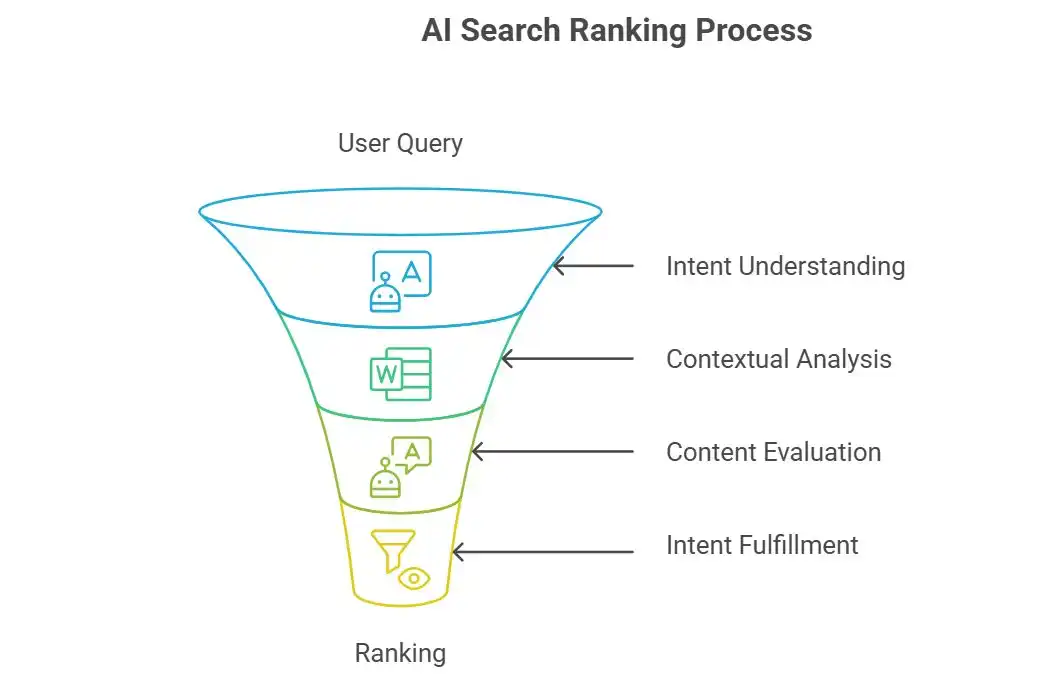
Keywords Lost Their Original Meaning
Traditional SEO was built on keywords. You found high-volume keywords and created content around them. The assumption was simple: more searches mean more value.
AI search systems work differently.
They focus on intent, not exact words. Users now ask long, natural questions. AI understands context, not just matching phrases.
This is why traditional SEO in the AI era feels outdated. It looks at keywords in isolation, while AI looks at meaning, purpose, and usefulness.
You may rank for a keyword.
But if your content does not fully solve the intent, AI skips you.
When Traffic Stops Being the Main Signal
Another reason traditional SEO fails is measurement. For years, traffic was the main success signal. More traffic meant more growth. But AI search changes this logic.
AI may mention your brand. Quote your explanation. Use your data.
Yet send you no traffic.
Traditional SEO tools struggle here. They cannot properly track AI mentions, citations, or influence. This creates blind spots. You may be more visible than ever, but analytics make it look like you are losing.
Trust Is Shifting From Websites to AI Answers
Users are learning to trust AI-generated answers. They feel fast, clean, and unbiased. Especially younger users. Instead of comparing five blog posts, they trust one clear answer. This changes how authority works.
Traditional SEO builds trust through backlinks and rankings. AI builds trust through consistency, clarity, and repeated mention across sources.
If your brand is not clearly understood by AI systems, your authority slowly fades, even if your SEO looks “fine.”
Content Structure Became More Important Than Content Length
Traditional SEO often rewarded long content filled with keywords. AI systems prefer clarity.
They look for:
- Clear definitions
- Direct explanations
- Easy-to-quote sections
If your content hides the answer deep inside long paragraphs, AI may ignore it. This is another reason traditional SEO fails in AI-driven search.
The problem is not writing long content.
The problem is writing content that is hard to extract meaning from.
Why Traditional SEO Thinking Slows Teams Down
Traditional SEO teaches teams to optimise pages.
AI search forces teams to optimise understanding.
When teams focus only on:
- Rankings
- Keyword positions
- Link counts
They miss how AI actually reads and evaluates content.
This creates delayed reactions. Brands notice traffic drops late. By the time they adapt, competitors already adjusted their strategy.
Traditional SEO frameworks are slow because they depend on old feedback loops.
Discovery No Longer Starts Only on Google
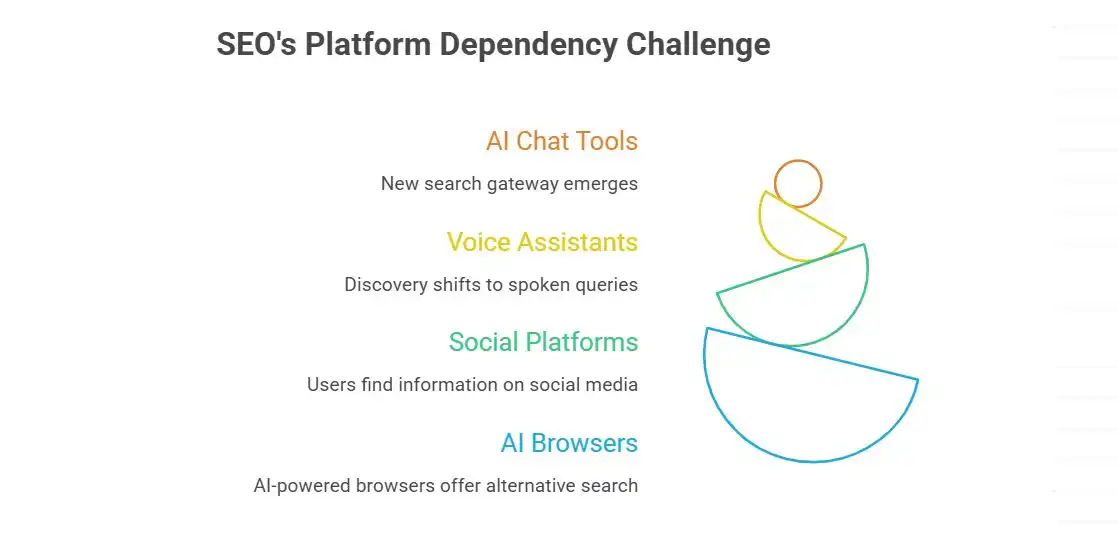
Another silent failure of traditional SEO is platform dependency.
People now search on:
- AI chat tools
- Voice assistants
- Social platforms
- AI browsers
Traditional SEO assumes Google is the main gateway. AI search breaks this assumption.
If your visibility depends only on Google rankings, your reach shrinks as discovery spreads elsewhere.
This is especially risky for B2B, education, and service brands.
Traditional SEO Was Built for Pages, Not Entities
AI systems think in entities.
Brands, people, products, concepts.
Traditional SEO thinks in pages and URLs.
This mismatch matters.
AI prefers brands that are clearly defined, consistently mentioned, and easy to understand across the web. Traditional SEO focuses on optimising individual pages, often in isolation.
When AI looks for trusted sources, disconnected pages struggle.
Why This Doesn’t Mean SEO Is Dead
It’s important to be clear.
SEO is not dead.
Traditional SEO is incomplete.
The failure comes from using old methods in a new environment. AI did not remove search. It changed how search decides what matters.
What worked before is no longer enough on its own.
What This Means for Businesses Right Now
If you rely only on traditional SEO, you may feel:
- Confused by falling traffic
- Unsure why rankings don’t help
- Frustrated by unclear ROI
This is not a content quality issue alone.
It is a system shift.
Understanding why traditional SEO fails in the AI era helps you stop chasing outdated signals and start preparing for new ones.
The Quiet Shift Happening Behind the Scenes
The biggest change is silent.
AI decides:
- Which brands are trustworthy
- Which explanations are clear
- Which sources are useful
This happens even when users don’t click.
Traditional SEO cannot fully explain this behaviour yet. That’s why many brands feel lost.
But awareness is the first step.
Final Thoughts: Why Traditional SEO Needs to Evolve
Traditional SEO was built for a world where clicks mattered most.
The AI era values answers, clarity, and trust.
If your strategy only chases rankings, it will slowly fail.
If it focuses on being useful, clear, and consistently understood, it will adapt.
The goal is no longer just to rank.
The goal is to be recognised.
Search has changed.
SEO must change with it.