Many people are trying to understand how Technical SEO works in a world where AI search engines control what gets shown. You may feel unsure because older rules no longer give the same results.
Slowly, it becomes clear that AI-driven systems read your website differently. They don’t just “index” your pages they extract, segment, verify, and cite them in real time. This is why a fresh look at Technical SEO for AI Search becomes important right now, and why this guide exists.
Here are 8 key areas we’ve picked to help you understand what actually matters in 2026, how it works, and how AI search changes the way you approach modern technical SEO.
Ultra-Fast Performance and AI-Focused Speed Signals
AI search engines depend on speed because they generate answers live. You start noticing how even small delays affect your chances of being included in AI Overviews or agent responses. This is why server response time feels more important than ever, especially when you see that AI retrieval systems work within very small latency windows.
As you go deeper into Technical SEO for AI Search, speed becomes less about page “load time” and more about interaction stability. Metrics like INP help you understand how quickly your page reacts when someone interacts with it. You may also notice how AI crawlers like GPTBot, PerplexityBot, and ClaudeBot rely on clean, open access to your content for real-time extraction.
What Most People Miss About Speed in AI Search
- AI models judge your site’s “retrieval quality” first, not visuals.
- Server response under 200ms becomes a soft threshold for AI inclusion.
- INP matters because unstable pages break AI extraction.
- Heavy JavaScript slows down AI crawlers, so clean HTML becomes useful again.
- Many sites block AI crawlers in firewalls without realising they’re removing their content from emerging search channels.
Additional Clarity
When you allow AI bots to crawl freely, it doesn’t guarantee ranking. It simply makes your content available to be cited. This small shift helps you see technical SEO as support for AI access, not just for traditional indexing.
Gently moving forward, you begin to understand how speed supports every other element in your AI search strategy.
Semantic Schema and Entity Strength in an AI-Driven Web
As AI search grows, schema starts feeling like a structured “nutritional label” for your website. You may notice that it helps AI clarify who you are, what the page covers, and whether your brand is trustworthy enough to cite. This is where linked entities and precise relationships provide real value.
When you strengthen entities through sameAs links, nested schema, and clear author details, AI systems understand your identity more deeply. This reduces confusion and helps your content appear in generative summaries when users ask for trusted answers.
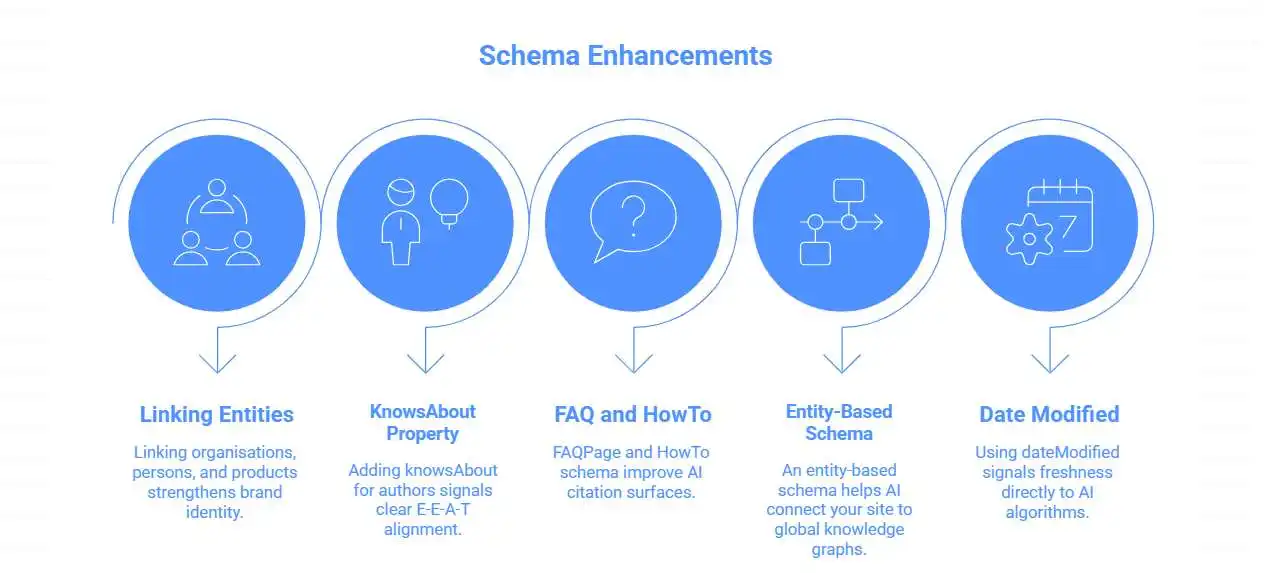
The Most Helpful Schema Enhancements in 2026
- Linking organisations, persons, and products strengthens brand identity.
- Adding knowsAbout for authors signals clear E-E-A-T alignment.
- FAQPage and HowTo schema improve AI citation surfaces.
- An entity-based schema helps AI connect your site to global knowledge graphs.
- Using dateModified signals freshness directly to AI algorithms.
Additional Clarity
You may start seeing schema as part of your brand’s digital reputation. It supports AI comprehension rather than simply aiming for rich snippets, which is why it matters more in 2026.
This makes it easier to move into how structure affects AI extraction.
Clean Architecture and Answer-First Formatting
Many people wonder why their detailed content doesn’t appear in AI summaries. You slowly realise that AI systems extract specific passages instead of processing entire pages. This is where answer-first formatting helps you deliver clear, liftable insights that AI can cite cleanly.
When you use H2S, H3S, direct summaries, and semantic HTML elements, you create modular content blocks. These blocks allow AI search engines to “pull” meaningful answers without confusion. As you do this, you also avoid the old problem of “div soup,” which often hides content from fast parsers.
Why Modular Formatting Helps AI Search
- AI models prefer short, clear, factual introductions under each section.
- Clean HTML (<article>, <section>, <ul>) is easier for AI to parse.
- Regular updates and the dateModified schema improve freshness signals.
- Passage-level clarity increases citation likelihood.
- Reducing nested divs avoids rendering inconsistencies.
Additional Clarity
It becomes clearer that structure is not for design, it’s for machine comprehension. You shape the page so AI systems can capture meaning quickly.
This prepares you for more advanced accessibility ideas in AI-driven environments.
Multi-Modal Accessibility and Machine-Readable Media
AI search relies on more than text. You may notice how image alt text, video transcripts, and diagrams play a bigger role in keyword retrieval and entity confirmation. When visuals become machine-readable, AI systems understand your content more deeply, which increases your presence in multimodal results.
Transcribing video and audio files also helps AI extract concepts. This reduces the chance of missing important context simply because the information was locked in a media file.
What Makes Media AI-Friendly in 2026
- Alt text should summarise the meaning, not just describe the object.
- Full transcripts help AI models analyse concepts within video or audio.
- Captions and descriptions reduce semantic gaps for AI systems.
- Clean file names and titles help with entity-based recognition.
- Adding structured data for videos improves AI retrieval reliability.
Additional Insight
When you think of media as “data containers,” you begin structuring them in a way that supports AI comprehension naturally.
With this understanding, you’re ready to explore how AI agents access data beyond regular crawling.
Programmatic Access and AI-Friendly Data Delivery
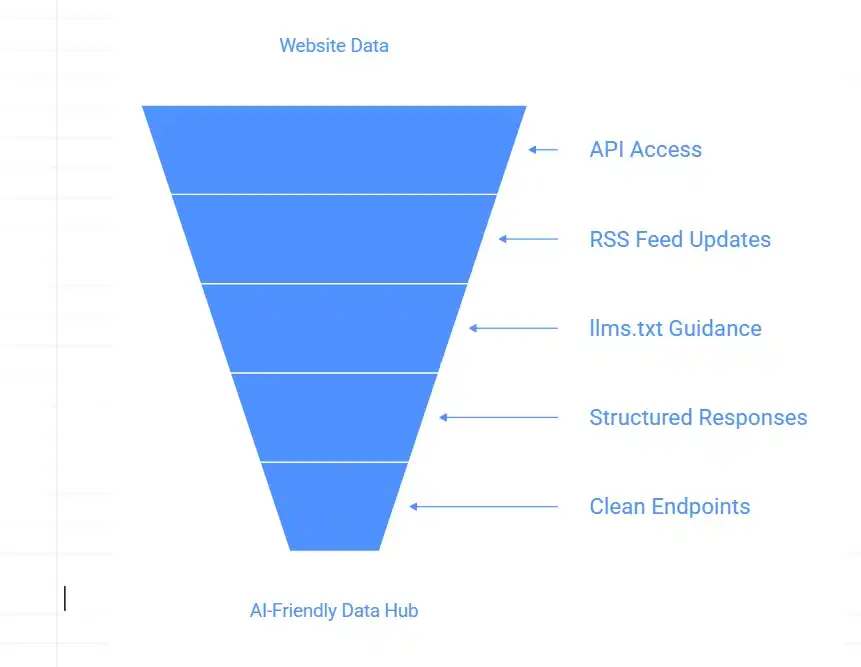
You may have seen AI agents booking services, comparing products, or pulling data directly from sources. This is where APIs, structured feeds, and llms.txt start becoming part of technical SEO for AI search. These tools help AI systems access your information quickly, accurately, and in a structured format.
When your site offers clear pathways for AI to access your data through APIs, RSS feeds, or instructions within llms.txt, you reduce misinterpretation. This shift shows how technical SEO now includes infrastructure for AI agents, not just web crawlers.
How AI Agents Interact With Your Data
- APIs offer real-time product or service data for agents.
- RSS/Atom feeds support live content retrieval and updates.
- llms.txt guides AI models on how to use your content.
- Structured responses reduce extraction errors.
- Clean endpoints make your data more accessible for comparisons.
Additional Clarity
You may start seeing your website as a data hub rather than only a content platform. This mindset makes AI search optimisation smoother and more predictable.
Now it becomes easier to understand the technical pillars behind crawlability and indexing.
Crawlability and Indexing in the Age of AI Search
Crawlability still forms the base of technical SEO, but the way AI systems crawl is broader. You begin noticing not only Googlebot but also GPTBot, PerplexityBot, and other AI crawlers accessing your pages. This makes robots.txt and firewall rules more important than before.
XML sitemaps, clean URLs, and stable redirects help both search engines and AI agents understand your structure. Managing crawl budget also becomes clearer when you avoid chains, loops, and gated content that block AI extraction.
Technical Elements That Matter Most for AI Crawlability
- Robots.txt should allow AI crawlers unless you want to avoid citations.
- XML sitemaps keep important URLs structured and visible.
- Redirects must be clean to avoid losing crawl budget.
- Flat hierarchy keeps content easy to reach.
- Removing thin pages reduces wasted crawling.
Additional Clarity
You see how “being crawlable” now includes multiple types of AI systems. This creates a healthier foundation for visibility across emerging search platforms.
This naturally leads to performance, rendering, and dynamic content.
Rendering, JavaScript, and Modern Framework Readability
If your site uses React, Vue, or Next.js, you may already know how rendering affects SEO. AI search brings new signals here because models depend on fully rendered HTML to extract content. When rendering fails, AI systems miss key sections, so the page becomes less reliable.
Server-side rendering (SSR), hydration improvements, and pre-rendering help ensure your content is visible before JavaScript executes. This makes your pages clearer to both search engines and AI retrieval models.
JavaScript Considerations for AI Search
- Render core content server-side to avoid delays.
- Use tools like Prerender.io for dynamic pages.
- Keep HTML structure clean for easier extraction.
- Lazy-load non-critical scripts to improve INP.
- Monitor how AI crawlers render pages using server logs.
Additional Clarity
Dynamic frameworks are still strong choices, they just need predictable rendering. You begin designing pages that load meaning first and functionality second.
And with this, you’re ready to see how security influences trust signals.
Security, Accessibility, and Trust Signals in AI Search
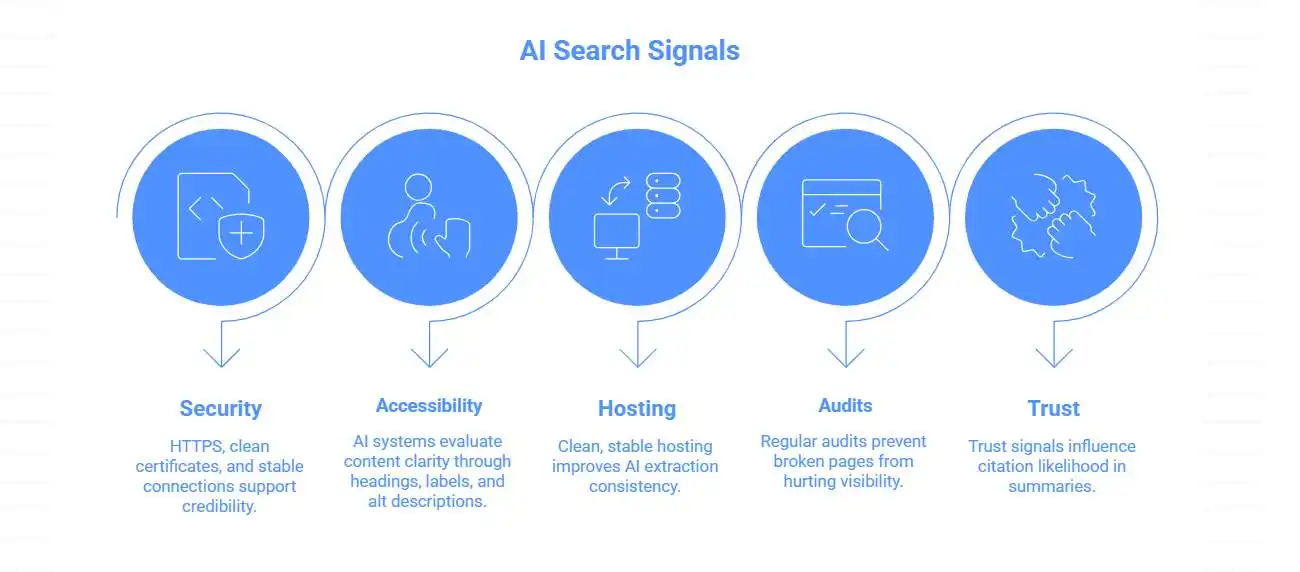
A secure site supports credibility. AI models look for HTTPS, clean certificates, and stable connections. You may also find accessibility becoming more important because AI systems evaluate content clarity through headings, labels, and alt descriptions.
As you improve accessibility, you help AI understand your content more reliably. This includes ARIA labels, consistent heading order, descriptive link text, and readable layouts.
How Security Supports AI Visibility
- HTTPS signals user safety and content reliability.
- Accessibility helps AI models interpret structure.
- Clean, stable hosting improves AI extraction consistency.
- Regular audits prevent broken pages from hurting visibility.
- Trust signals influence citation likelihood in summaries.
Additional Clarity
Security becomes more than protection it becomes a readability enhancer. It ensures AI systems experience your site the same way humans do.
Now you can bring all ideas together as Technical SEO evolves into an AI-first discipline.
Conclusion
As you move through Technical SEO for AI Search, you begin understanding how every element speed, schema, structure, rendering, media, and security now supports machine comprehension. AI search doesn’t replace SEO, it reshapes it.
You slowly notice that your role is not only to help search engines discover your pages, but to present your information clearly for AI agents that retrieve, verify, segment, and cite content in real time.
By focusing on these technical foundations, you give your site a better chance to appear naturally not just in Google, but across the entire AI-driven search ecosystem in 2026.