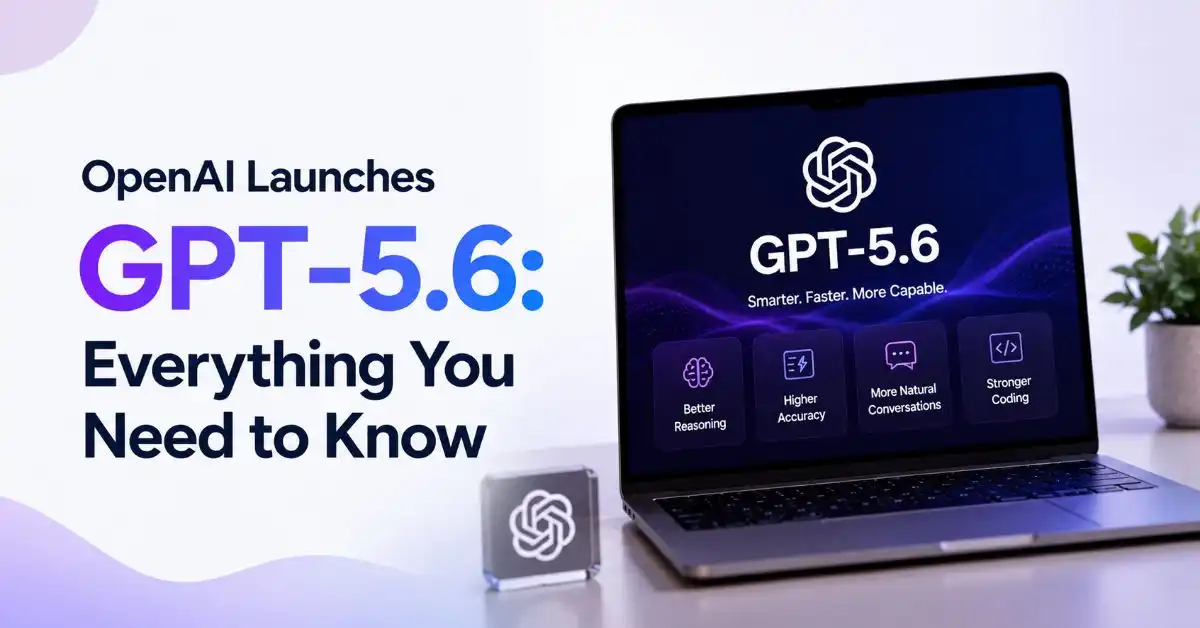
OpenAI has officially introduced GPT-5.6, its newest family of AI models designed to deliver more intelligence from every token, faster performance, and better cost efficiency. The release includes three models, GPT-5.6 Sol, GPT-5.6 Terra, and GPT-5.6 Luna, each built for different workloads while sharing significant improvements in coding, reasoning, agentic AI, and knowledge work.
Instead of simply increasing model size, OpenAI focused on making GPT-5.6 more efficient. The company says the new models complete more work using fewer tokens, reducing both latency and overall costs for developers and businesses.
What’s New in GPT-5.6?
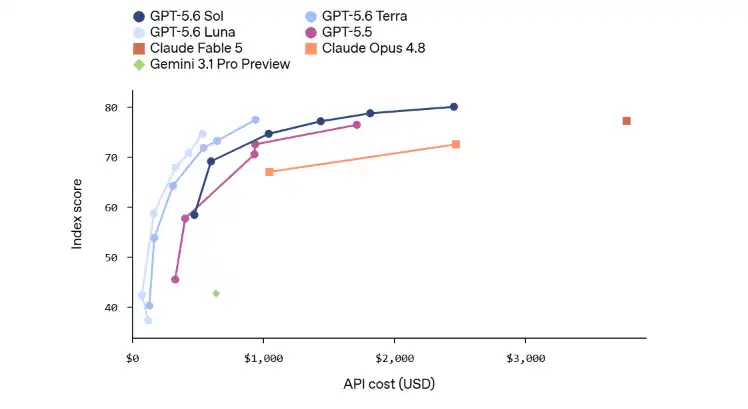
GPT-5.6 introduces a completely redesigned model family:
- GPT-5.6 Sol – The flagship model offering the highest intelligence and strongest overall performance.
- GPT-5.6 Terra – A balanced model designed for everyday business and professional tasks.
- GPT-5.6 Luna – The fastest and most affordable model for high-volume workloads.
According to OpenAI, this new model lineup allows users to choose the right balance between performance, speed, and cost based on their specific use case.
Better Coding and Software Development
One of the biggest upgrades in GPT-5.6 is its coding ability.
OpenAI says GPT-5.6 Sol achieves state-of-the-art performance across several coding benchmarks while using fewer output tokens, reducing response time, and lowering API costs compared to previous models. It also performs strongly on software engineering benchmarks such as Terminal-Bench 2.1 and DeepSWE, making it more capable of handling complex development workflows.
Developers can also benefit from Programmatic Tool Calling, allowing GPT-5.6 to write and execute lightweight programs that coordinate multiple tools and process intermediate results more efficiently.
Smarter Knowledge Work and Multi-Agent AI
GPT-5.6 is designed for more than coding.
The model can analyze documents, work with spreadsheets, create presentations, browse information, and handle long-running professional workflows.
OpenAI has also introduced an Ultra capability that coordinates multiple AI agents in parallel to solve demanding tasks faster. This approach enables GPT-5.6 to divide complex work into multiple streams before combining the results into a single response.
These capabilities make GPT-5.6 particularly useful for researchers, consultants, analysts, and enterprise teams managing complex projects.
Improved Design and Computer Use
GPT-5.6 also delivers significant improvements in design quality.
The model can generate polished presentations, editable documents, spreadsheets, and user interfaces while maintaining consistent layouts, typography, and formatting.
OpenAI says GPT-5.6 can inspect rendered outputs, identify design issues, and refine its work before presenting the final result, making it a stronger collaborator for creative and professional tasks.
Stronger Safety and Security
Alongside performance improvements, OpenAI has strengthened the model’s safety systems.
GPT-5.6 includes:
- Improved cybersecurity safeguards
- Better protection against misuse
- Layered safety monitoring
- More robust real-time checks
- Enhanced defensive capabilities for trusted users
The company says GPT-5.6 underwent its most extensive safety testing to date before public release, including large-scale automated testing and expert red-teaming.
GPT-5.6 Pricing

OpenAI has announced pricing for all three GPT-5.6 models.
GPT-5.6 Sol
- $5 per million input tokens
- $30 per million output tokens
GPT-5.6 Terra
- $2.50 per million input tokens
- $15 per million output tokens
GPT-5.6 Luna
- $1 per million input tokens
- $6 per million output tokens
This pricing structure allows developers to select a model that best matches their performance requirements and budget.
Availability
GPT-5.6 is available across:
- ChatGPT
- OpenAI API
- Codex
- ChatGPT Work
Depending on the subscription plan, users can access different GPT-5.6 models and reasoning levels, including the new Ultra mode for the most demanding tasks.
Also Read: Claude Sonnet 5: Features, Pricing, and What’s New
Final Thoughts
With GPT-5.6, OpenAI is focusing on smarter efficiency rather than simply increasing model size. The introduction of Sol, Terra, and Luna gives users greater flexibility while improving coding, reasoning, knowledge work, design, and multi-agent capabilities.
For developers, businesses, and enterprise teams, GPT-5.6 represents a significant step forward by delivering stronger performance, lower costs, and more capable AI workflows in a single model family.
Frequently Asked Questions
What is GPT-5.6?
GPT-5.6 is OpenAI’s latest family of AI models that includes GPT-5.6 Sol, Terra, and Luna. The models offer improved reasoning, coding, knowledge work, and multi-agent capabilities with better performance per dollar.
What are the different GPT-5.6 models?
The GPT-5.6 family includes three models:
- GPT-5.6 Sol (flagship)
- GPT-5.6 Terra (balanced)
- GPT-5.6 Luna (fastest and most affordable)
What is GPT-5.6 Ultra?
GPT-5.6 Ultra is a high-capability mode that coordinates multiple AI agents in parallel to complete complex tasks faster and more accurately.
How much does GPT-5.6 cost?
GPT-5.6 pricing starts at $1 per million input tokens for Luna, $2.50 for Terra, and $5 for Sol. Output token pricing varies by model.
Where can I use GPT-5.6?
GPT-5.6 is available in ChatGPT, the OpenAI API, Codex, and ChatGPT Work, with access depending on your subscription plan.