
Anthropic just did something worth paying attention to. On July 24, 2026, it released Claude Opus 5, a model that gets close to the power of its top-tier AI, yet costs about half as much to run. So if you build products, market a brand, or run a business on AI, this is one launch you will actually want to understand.
The short version is simple. Opus 5 is faster, sharper, and cheaper for the value it delivers, and it is built to handle the kind of long, complex work that used to trip models up. Let us break down what changed and why it matters.
What Is Claude Opus 5?
In plain terms, Opus 5 is Anthropic’s newest flagship model, and it sits at the top of the everyday Opus tier. What makes it stand out is the balance it strikes, because it comes close to the frontier intelligence of Anthropic’s most capable model, Fable 5, while costing roughly half the price.
That combination is the whole story. You get near-top-tier reasoning without paying top-tier rates, which is exactly why it is now the default model on Claude Max and the strongest option on Claude Pro. In other words, it is designed to be used every single day, not saved for special occasions.
What’s New in Opus 5
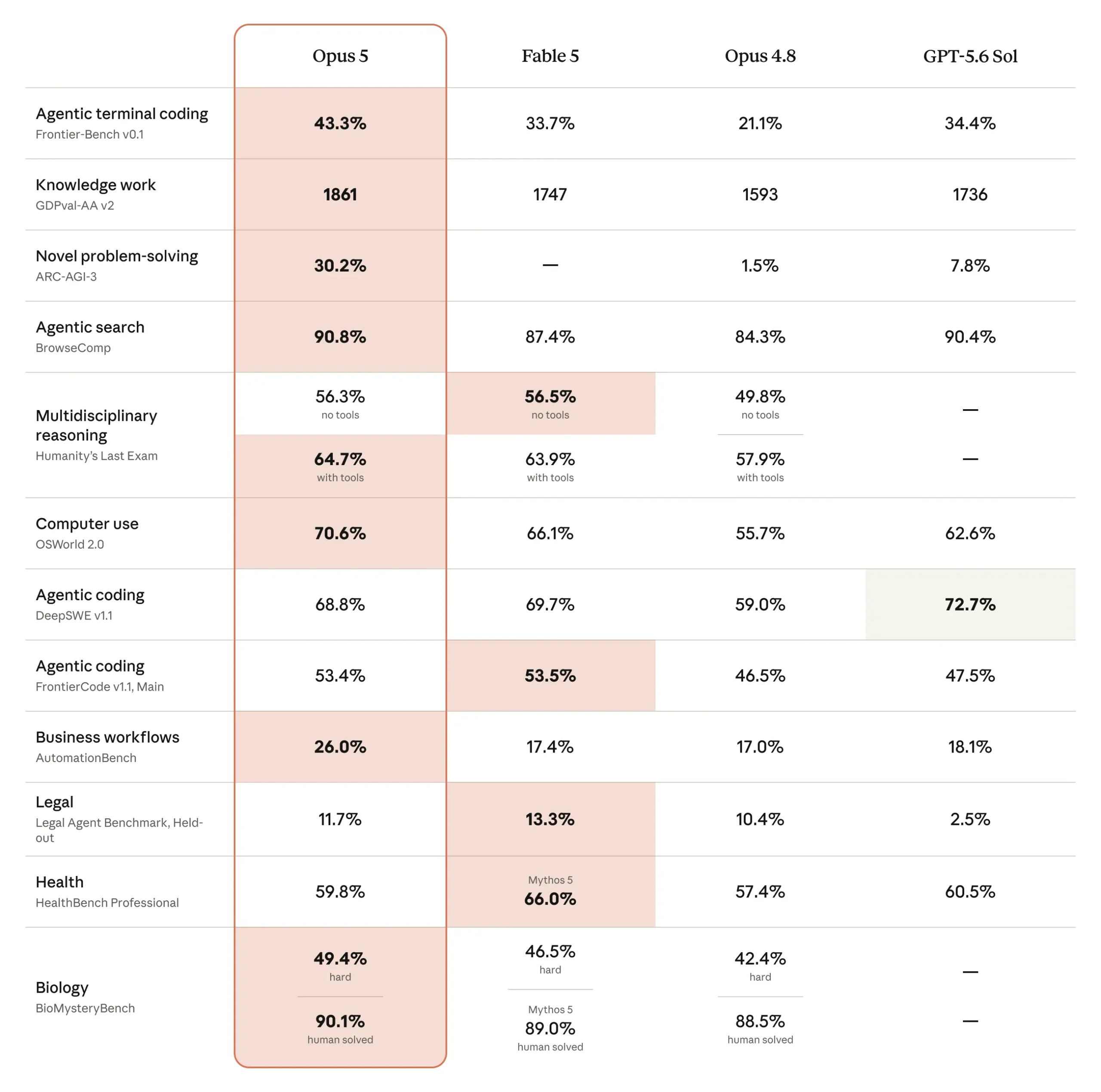
So what are the actual Opus 5 features that matter? A few upgrades stand out, and together they add up to a real generational leap over Opus 4.8.
- State-of-the-art coding: On tough software engineering benchmarks, Opus 5 is now the best model available, and in some tests it more than doubles the score of Opus 4.8 at a lower cost per task.
- Stronger agentic work: It shines on long, multi-step tasks, so it can carry a complex job from start to finish rather than losing the thread halfway through.
- It checks its own work: Instead of rushing to an answer, Opus 5 verifies, catches its own mistakes, and iterates until the job is truly done. Early testers describe it as behaving more like a careful professional than a tool.
- Better visual output: Anthropic says it produces noticeably stronger visuals, from cleaner interfaces to interactive 3D work.
- Safer and more aligned: On top of all that, Anthropic calls it their most aligned and safest model to date, with the lowest rates of deceptive behavior they have measured.
Opus 5 vs Opus 4.8: What Actually Changed
Naturally, the first question most people ask is how it compares to the model before it. When you line up Opus 5 vs Opus 4.8, the pattern is clear. You get more performance for the same money.
Here is the key part. Anthropic priced Opus 5 exactly the same as Opus 4.8, so you are not paying extra for the upgrade. Early customers report big gains too, especially on hard tasks like debugging, financial modeling, and long analytical work, and often with fewer tokens and less time. In short, it does more, and it does it more efficiently.
Also Read: Claude Sonnet 5: Features, Pricing, and What’s New
Claude Opus 5 Pricing and Availability
The good news is that it is available right now on all platforms. On the pricing side, Opus 5 costs $5 per million input tokens and $25 per million output tokens, which is the same rate as Opus 4.8. Developers can start building with it on the Claude API straight away.
If you need extra speed, there is also a Fast mode that runs around 2.5 times quicker, offered at twice the base price. And for everyday users, it is already live as the default on Claude Max and the top model on Claude Pro.
Why Opus 5 Matters for You
Benchmarks are nice, but here is why this release actually matters if you run a business or a brand. Because Opus 5 delivers near-frontier intelligence at half the cost, genuinely useful AI work just got cheaper and more reliable at the same time.
For marketers and founders, that means better content, research, and analysis without a bigger bill. For developers and agencies, it means an AI that can own long, messy tasks and check its own work, which is a real time-saver. And since it is safer and more consistent, you can trust it with more, which is often the thing holding teams back. As this Claude AI model keeps getting stronger and cheaper, the brands that learn to use it early will simply move faster than everyone else.
Also Read: Claude Opus 4.7: The AI Tool That Could Reshape Web Design
Bottom Line
Claude Opus 5 is more than a version bump. It brings near-top-tier intelligence to an everyday price, leads on coding and agentic work, checks its own output, and arrives as Anthropic’s most aligned model yet, all at the same cost as before. If AI is part of how you work, this is one worth trying for yourself.
You can read Anthropic’s full announcement here.
FAQs
What is Claude Opus 5?
Claude Opus 5 is Anthropic’s newest flagship AI model, released on July 24, 2026. It delivers intelligence close to Anthropic’s top model, Fable 5, at about half the cost, and it is now the default on Claude Max and the strongest model on Claude Pro.
Is Opus 5 better than Opus 4.8?
Yes. Opus 5 outperforms Opus 4.8 across coding, knowledge work, and agentic tasks, in some cases more than doubling its scores, while costing the same. Early users also report better accuracy with fewer tokens and less time.
How much does Opus 5 cost?
Opus 5 pricing is $5 per million input tokens and $25 per million output tokens, the same as Opus 4.8. A Fast mode that runs around 2.5 times quicker is available at twice the base price.
What can Opus 5 do?
It excels at software engineering, long multi-step agentic tasks, self-checking its work, and producing strong visual output. It is also Anthropic’s most aligned and safest model to date, making it easier to trust with bigger jobs.