Traffic drops can feel confusing when nothing looks broken.
Your pages still rank. Your content still feels helpful. Yet fewer people are clicking through. This quiet disconnect is where many site owners start questioning what changed.
The shift often traces back to Google AI Overviews. Instead of guiding users to websites, Google increasingly answers questions directly. Understanding this change clearly is the first step toward recovery.
How Google AI Overviews Are Changing Search Behavior
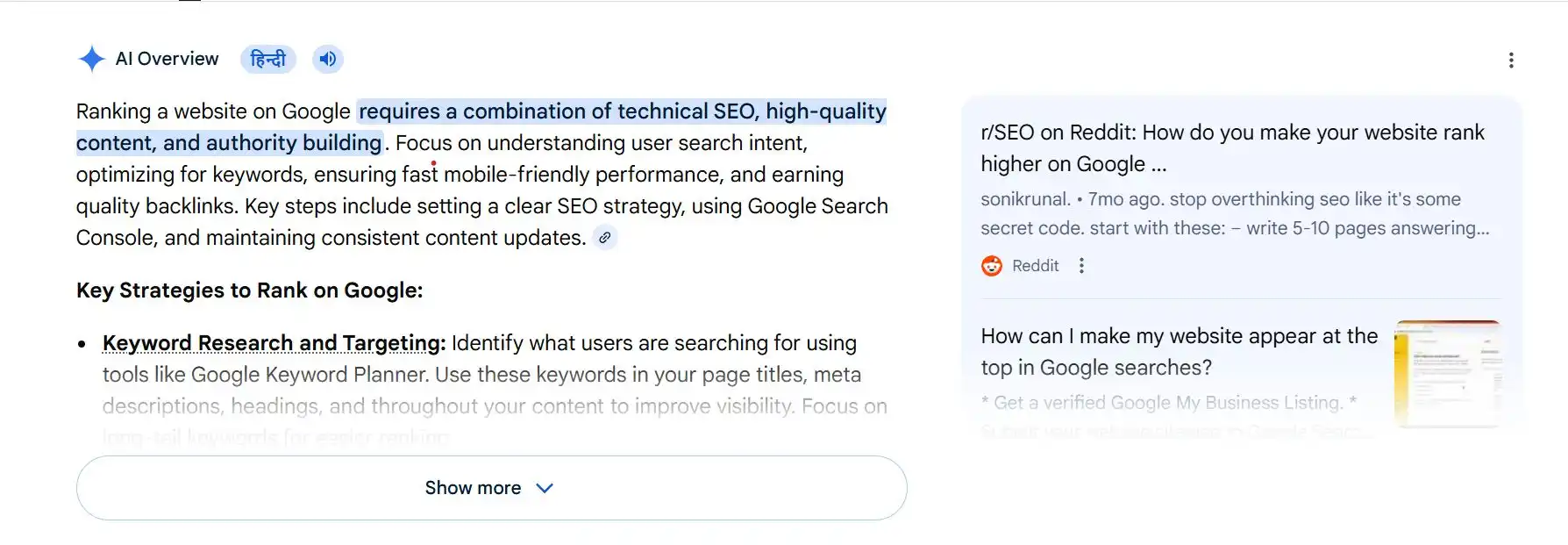
Google AI Overviews are not just another SERP feature. They fundamentally change how users interact with search results.
When someone searches, Google now tries to complete the journey instantly. The AI-generated summary appears before organic links, often satisfying intent without requiring a click. From a reader’s point of view, this feels efficient. From a website’s point of view, visibility quietly separates from traffic.
This shift means success is no longer measured only by rankings. It’s measured by whether your content is chosen, summarised, and trusted inside AI-driven responses.
Why AI Overviews Reduce Clicks
- Users get complete answers without visiting websites
- AI summaries push organic links below the fold
- Informational queries are resolved instantly
- Mobile users see AI content first
- Curiosity is satisfied early
What This Means for Website Owners
Google values fast resolution of intent. Pages that once attracted clicks now act as data sources. This doesn’t mean your content failed. It means search behavior evolved.
This distinction matters because it reframes the problem: traffic loss is structural, not personal.
Why Rankings Stay Stable but Traffic Drops
Many site owners feel confused when rankings look healthy but traffic declines.
From Google’s perspective, rankings still matter for sourcing information. From the user’s perspective, the journey often ends before reaching your link. AI Overviews create a layer where visibility exists without engagement.
This disconnect appears most clearly in informational content. Pages explaining “what,” “how,” or “why” are easier for AI to summarise, which reduces the need for exploration.
Signals That AI Overviews Are Affecting You
- Impressions remain stable while CTR drops
- Top positions show fewer visits
- Older informational pages lose traffic first
- Mobile traffic declines faster than desktop traffic
How Google Sees This Shift
Google does not treat this as a loss of relevance. It treats it as fulfilled intent. Understanding this prevents wrong fixes like rewriting titles or chasing keywords.
This clarity helps site owners stop misdiagnosing the problem.
How Google Chooses Content for AI Overviews
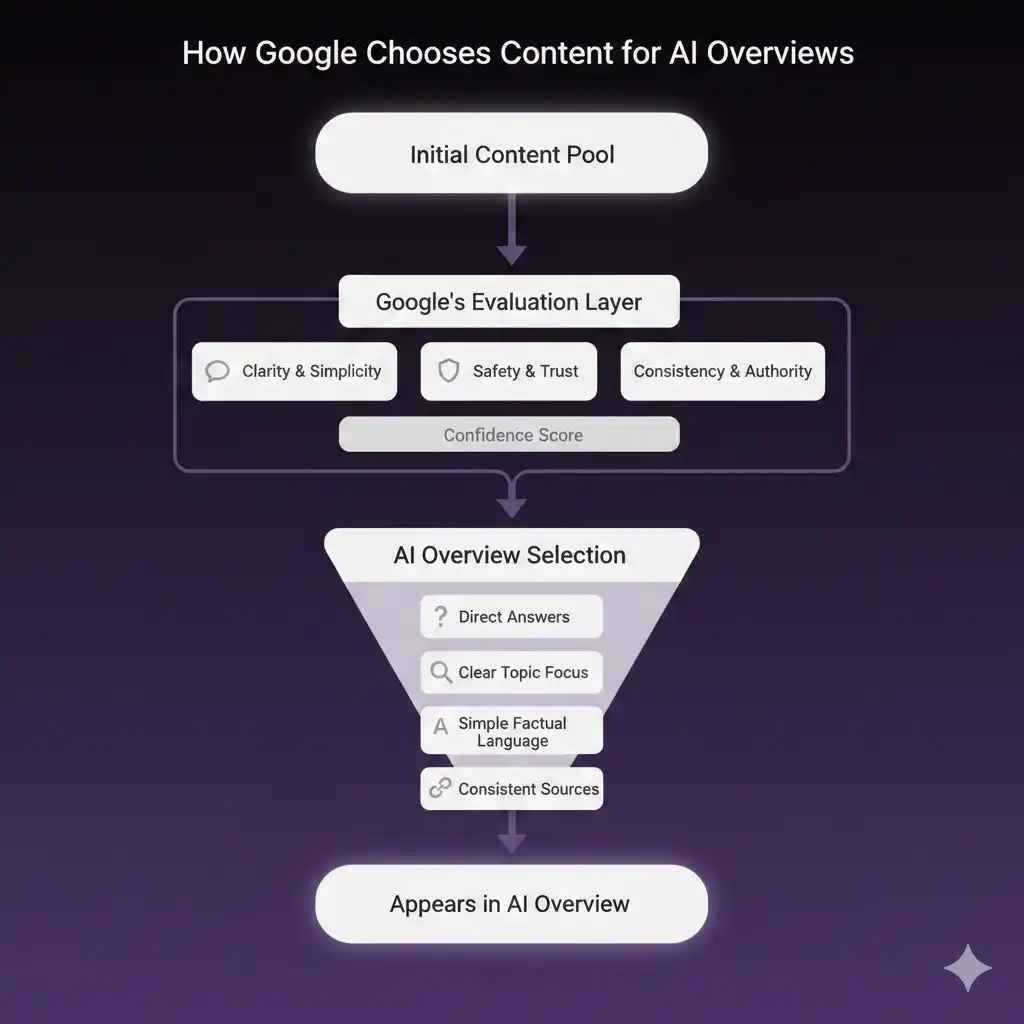
Google AI Overviews don’t pull content randomly.
They select information that feels easy to understand, safe to repeat, and consistent with other trusted sources. Pages that answer questions clearly and early are easier for AI systems to reuse.
From Google’s side, the goal is confidence. If content feels uncertain, vague, or scattered, it’s less likely to be summarised.
What Google’s AI Looks For
- Direct answers near the top
- Clear topic focus per section
- Simple language with a factual tone
- Logical flow without distractions
- Consistency across similar sources
Why This Affects Traffic
When AI confidently answers using your content, the user often doesn’t need to click. Visibility shifts from destination to reference.
This understanding sets the foundation for realistic recovery.
Why Informational Content Is Hit the Hardest
Not all content is affected equally by AI Overviews.
Informational pages are designed to explain. That makes them ideal for AI summaries. When Google can confidently answer using a short extract, the need for exploration disappears.
Pages that require judgment, experience, or decision-making still attract clicks. This difference explains why some sections of a site decline while others remain stable.
High-Risk Content Types
- Definitions and explanations
- Step-by-step guides
- Basic comparisons
- Introductory tutorials
What Google Values Here
Google values usefulness over visits. If the answer fits on the results page, it will stay there.
This helps prioritise which content needs rethinking first.
Diagnosing Traffic Loss Caused by AI Overviews
Recovery starts with clarity, not assumptions.
Many sites lose traffic without realising AI Overviews are involved. Diagnosis means observing patterns, not panicking. When impressions stay visible but clicks decline, AI interception is often the cause.
From Google’s point of view, this still counts as success. From your point of view, it’s a visibility mismatch.
Signs AI Overviews Are Intercepting Traffic
- CTR drops without ranking loss
- Traffic loss isolated to informational pages
- Reduced engagement on mobile
- Stable impressions with declining sessions
Why Diagnosis Matters
Fixing the wrong pages wastes effort. Diagnosis helps you adapt where it actually matters.
Shifting from Traffic Recovery to Visibility Strategy
Chasing lost clicks alone leads to frustration.
Google AI Overviews reward clarity and completeness, not persuasion. Instead of trying to pull users away from AI answers, recovery works better when content supports visibility within that system.
This doesn’t remove the value of traffic. It reframes how visibility works in an AI-driven SERP.
What Recovery Looks Like Now
- Accepting fewer clicks for some queries
- Strengthening presence inside summaries
- Building recognition beyond rankings
- Measuring impact beyond sessions
Why Google Values This
Google prioritises satisfaction. Pages that align with this goal remain relevant.
Creating Content That Still Attracts Clicks
AI Overviews handle summaries well. They struggle with depth.
Content that adds interpretation, experience, or real-world nuance gives users a reason to continue reading. This is where recovery becomes possible without fighting Google’s direction.
Instead of repeating what AI already summarises, successful pages extend the conversation.
Content That Still Wins Clicks
- Opinion-driven insights
- Real-world examples
- Case-based explanations
- Complex decision guidance
Why Google Allows This
Google understands AI limits. When depth is required, it still sends users outward.
Reducing Dependency on Search Alone
AI Overviews expose a long-standing risk: relying only on Google.
Recovery improves when traffic sources diversify. Direct visits, returning readers, and brand searches reduce vulnerability to SERP layout changes.
From Google’s perspective, strong brands signal trust. From your perspective, they stabilise growth.
Sustainable Visibility Channels
- Brand-driven searches
- Email and subscriptions
- Community engagement
- Returning audiences
Why This Supports SEO
Google rewards recognisable entities. Diversification strengthens authority signals.
Measuring Success in an AI-Dominated SERP
Looking only at traffic numbers no longer shows the full picture.
When Google AI Overviews display answers directly on the search page, many users get what they need without clicking. That does not mean your content failed. In many cases, users still see your information, understand it, and build trust with your brand before visiting later through a different path.
What to Measure Differently
- Impression trends – visibility even without clicks
- Brand searches – recognition after exposure
- Assisted conversions – delayed decision impact
- Returning user behaviour – trust building over time
Why Google Aligns With This
Google’s goal is not just to generate clicks. It wants users to find reliable and helpful answers quickly. Pages that support understanding and consistency tend to remain valuable over time.
Final Thoughts
Google AI Overviews are not removing value from content. They are changing how value is delivered across modern search experiences.
When AI presents answers directly, the role of content shifts from attracting clicks to shaping understanding. Your pages may still influence decisions, build trust, and guide users, even when visits are lower.
Traffic loss doesn’t mean irrelevance. It signals a need to adapt structure, depth, and expectations in a search environment shaped by AI-driven results and evolving user behaviour.
Search hasn’t ended. It has simply learned to answer first.