Ever noticed your traffic dropping even when your rankings look perfect?
It’s happening because Google’s AI Overviews now place AI-generated answers above everything else. Your content might still rank on page one, but users never scroll far enough to actually see it. This shift has quietly reduced visibility for websites that aren’t prepared for AI-first search.
Traditional SEO is no longer enough. Your content now needs to be structured, clear, and optimized in a way that Google’s AI can easily understand and choose.
In this guide, you’ll learn exactly how to make your content ready for Google AI Overviews how AI selects sources, what it cites, and the strategies that actually work in this new AI-driven search environment.
What Are Google AI Overviews?
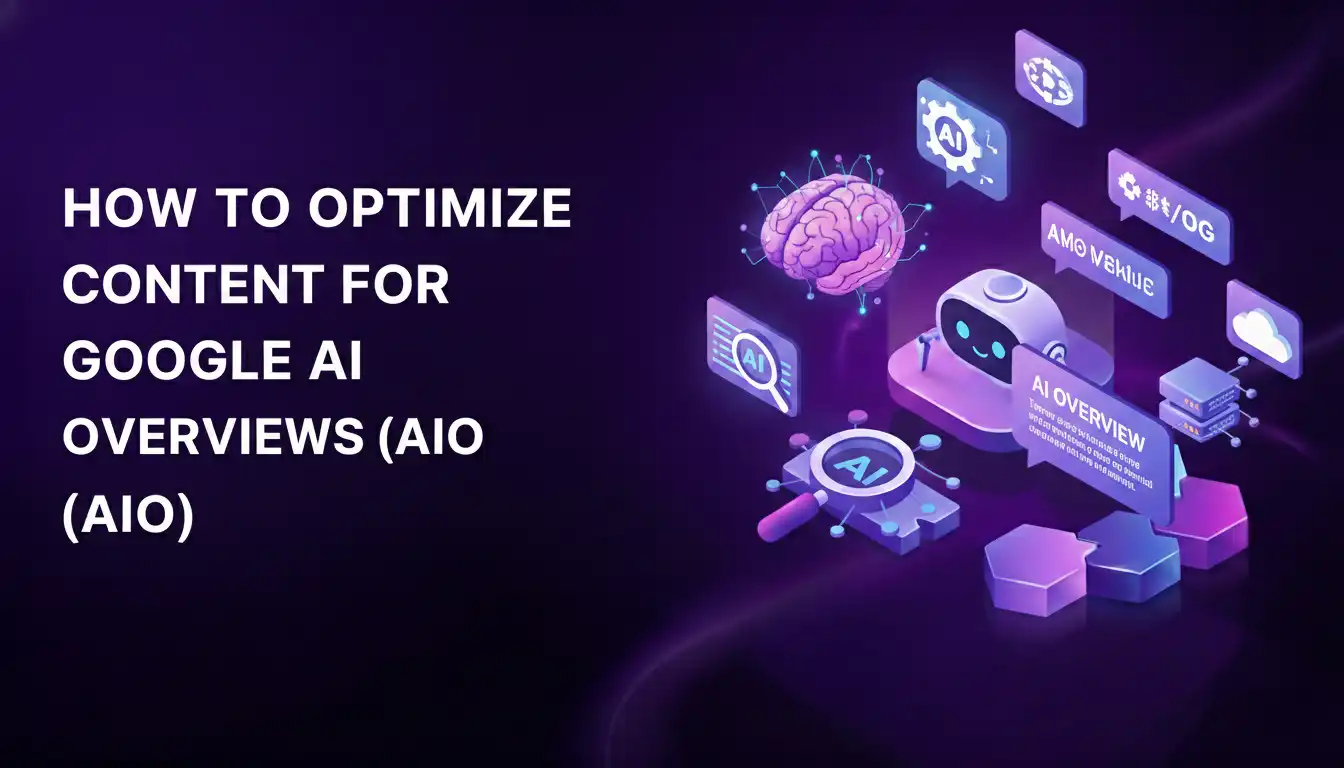
Google AI Overviews (AIOs) are AI-generated summaries that appear at the top of search results. They combine insights from multiple sources to create a quick, conversational answer that users can understand instantly.
For many queries, especially “how-to,” informational, and long-tail questions, AIOs dominate more than half of the visible screen. If your content isn’t included in these summaries, users may never see your page, even if you rank on page 1.
Google says AIOs pull content from pages that:
- Are clear and well-structured
- Support the AI-generated snapshot
- Expand on the topic in meaningful ways
- Demonstrate strong expertise and trust
Understanding this behavior is the foundation of your AIO optimization strategy.
Why Ranking in Google AI Overviews Matters
Being included in AI Overviews impacts your SEO far beyond organic rankings.
1. Top-Level Visibility
AIOs appear above all traditional search results, often taking up 70–80% of mobile screens. If your content is included, you get premium exposure regardless of your actual ranking.
2. Instant Authority
When Google AI chooses your page as a source, it acts like a credibility badge signaling your expertise to users and other algorithms.
3. Competitive Advantage
Most websites still focus only on traditional SEO. If you optimize early for AI Overviews, you get ahead while others are still catching up.
How Google AI Overviews Choose Content
To understand how to optimize, you must know how AIO selection works. Google uses a mix of semantics, structured content, authority, and user intent matching.
Here’s what AIO models prioritize:
Semantic Relevance
Semantic relevance means AI looks at the real meaning and intent of your content, not keyword repetition. Instead of rewarding keyword stuffing, it prefers pages that give clear, accurate answers to the user’s question. When your content directly matches the user’s intent, AI sees it as more valuable and is more likely to choose it.
Content Structure
AI favors content that’s easy to scan and clearly organized. When you use clear headings, short paragraphs, and well-structured lists, it becomes much easier for AI systems to understand your content and extract the exact passages that match a query. Since AI pulls specific sections rather than entire pages, strong content structure directly increases your chances of being included in AI Overviews.
E-E-A-T Signals
Google AI Overviews prioritize content with strong E-E-A-T signals real experience supported by first-hand insights, genuine expertise backed by credentials, solid authoritativeness through citations and backlinks, and trustworthiness shown through accuracy and transparency. Content that meets these qualities has a significantly higher chance of being selected by AI.
Technical Accessibility
AI Overviews can only pull information from content that is fully accessible and easy to interpret, which means using clean HTML text, crawlable pages, proper schema, and fast-loading structure. If your content is blocked, hidden behind JavaScript, or poorly organized, Google’s AI won’t be able to access or extract it, and it won’t be used in AIO results.
How to Optimize Content for Google AI Overviews (AIO)
Below are the most effective strategies based on Google’s documentation, AI Overview analysis, and large-scale performance studies.
1. Follow Google Search Essentials (Foundation Step)
Before you focus on AIO optimization, your site must first meet Google’s core requirements. Google only selects content from sites that are trustworthy, accessible, and user-focused. If these basics are missing, AI Overviews won’t use your content, no matter how well it’s written.
Key essentials:
- Crawlable, accessible content
- No spam or manipulative elements
- Helpful, user-first information
- Clear and organized site structure
- Updated, accurate, and trustworthy content
2. Target Long-Tail, Intent-Focused Queries
Google AI Overviews appear more frequently for specific, informational queries rather than broad keywords. For example, instead of targeting a generic term like “SEO,” focus on queries such as “how to optimize content for Google AI Overviews.” Similarly, rather than “camera cleaning,” aim for more precise questions like “how to clean a DSLR camera safely at home.”
Why this works:
- These queries show clear user intent
- They naturally require detailed, step-by-step explanations
- AI Overviews prefer well-structured, instructional content
Make sure your content focuses on real user questions instead of broad, traditional keywords.
3. Answer the Query Quickly
AI Overviews favor content that answers the main question early. Start with a brief introduction, give the core answer within the first few paragraphs, and then expand with details below. If your main answer is buried too deep, AI may skip your page entirely.
Best practices:
- Introduce the topic briefly
- Answer the primary question within 2–3 paragraphs
- Place supporting details and explanations afterward
4. Structure Content for AI Extraction
AI doesn’t read like humans, it extracts. To help AI pull your content into AIOs, use:
Clear H2/H3 hierarchies
Each subheading should reflect a common question or action step.
Short paragraphs (2–3 sentences max)
This allows AI models to lift passages cleanly.
Bullet points and numbered lists
Perfect for structured reasoning and step-by-step answers.
Tables for comparisons
AI often includes table data directly in Overviews.
Definition-style sentences
Example: Google AI Overviews are AI-generated summaries that appear at the top of search results.
These formats make your content easier for AI to scan and summarize, improving your chances of inclusion.
5. Strengthen E-E-A-T for AI Search
In Google AI Overviews, E-E-A-T is a major selection factor. The stronger your Experience, Expertise, Authoritativeness, and Trustworthiness, the more confidently AI can use your content as a reliable source, especially in sensitive YMYL categories like health, finance, and legal.
Experience: Show real, first-hand involvement with the topic. Add personal examples, case studies, practical insights, or results that prove you’ve actually used or tested what you’re explaining.
Expertise: Demonstrate your knowledge by including author bios, relevant credentials, professional backgrounds, or verified profiles. This helps Google understand the content comes from a qualified source.
Authoritativeness: Build credibility with external validation. Earn high-quality backlinks, digital PR mentions, expert quotes, or references from trusted industry sites. When others cite you, Google sees you as authoritative.
Trustworthiness: Maintain accuracy and transparency. Use updated statistics, cite reliable sources, ensure your content is factual, and keep policies or disclosures clear. Strong trust signals make your content safer for AI to feature.
6. Use Structured Data (Schema Markup)
Schema helps Google understand the purpose and structure of your content. It provides AI with clean, machine-readable context, making it easier for Google to interpret and extract key information.
The most effective schema types for AI Overviews include:
- FAQPage
- HowTo
- Article
- WebPage
- Product
- Person (author schema)
Using these schema types correctly increases your chances of being included in AIO results.
7. Update Content Regularly (Freshness Signals)
Google AI Overviews prefer content that is fresh and regularly updated. Pages that show recent activity signal reliability and relevance, making them more likely to be selected by AI systems.
Useful update signals include:
- Adding new statistics
- Rewriting or refreshing the introduction
- Updating steps or instructions
- Including new FAQs
- Replacing or improving images
- Updating or expanding schema markup
Freshness is one of the strongest signals for AI-driven ranking and extraction.
8. Optimize Content for Conversational Search
AI Overviews are designed to answer natural, conversational queries, so your content should be written in a way that feels human and easy to understand. Clear, natural language makes it easier for AI to interpret and extract your information.
Best practices:
- Use a conversational tone
- Avoid robotic or keyword-stuffed writing
- Include phrases users would naturally search
- Add question-based headings
Since AIOs are powered by LLMs, they prefer simple, direct, human-style content
9. Build Topical Authority
To be selected by Google AI Overviews, you need more than a single strong article you need consistent expertise across an entire topic. This is where topical authority comes in, helping Google understand that your site is a reliable and knowledgeable source.
How to build topical authority:
- Create topic clusters
- Publish supporting, related articles
- Interlink posts logically
- Offer deep, detailed guides
Strong topical authority increases your chances of being chosen for AIOs.
10. Ensure Technical Accessibility for AI Crawlers
Google AI models use Googlebot along with AI-specific crawlers such as Google-Extended, Gemini crawlers, and other AI partners. To ensure your content is eligible for AI Overviews, it must be fully accessible to these crawlers.
Make sure your content is:
- Allowed and crawlable in robots.txt
- Not blocked or hidden behind JavaScript
- Fully mobile-optimized
- Fast-loading and technically clean
If AI crawlers can’t access your content, they can’t use it in Overviews.
11. Earn High-Quality Backlinks
Backlinks still play an important role in AI Overviews, not just for traditional rankings, but as credibility signals. Google AI tends to favor sources that are referenced or mentioned by reputable, trustworthy websites.
To strengthen your backlink profile, focus on relevance, high-quality editorial mentions, digital PR coverage, and placements in niche publications. Even one strong authority backlink can impact AI Overviews more than dozens of low-quality links.
12. Improve Brand Visibility Across Platforms
AI Overviews look beyond just your website and assess your full digital presence. This includes your activity and visibility across social platforms, podcasts, YouTube videos, online reviews, and community discussions on sites like Reddit or Quora.
All of these signals contribute to your overall authority. Even unlinked brand mentions help strengthen credibility and improve your chances of being selected or cited in Google AI Overviews.
Conclusion
Google AI Overviews are reshaping how search works, and the brands that adapt early will gain the strongest visibility. As AI takes a bigger role in deciding what information to show and which sources to trust, your content must be structured, credible, and optimized for AI.
While the core principles remain the same clarity, trust, expertise, and helpfulness the way Google extracts and uses information has changed. Your content now needs to be easier for AI to read, understand, and pull from.
When your strategy aligns with how AIOs work, your content becomes more discoverable and more likely to be selected. In the new era of searchable AI, being chosen is everything, and optimizing for AI Overviews is where your visibility begins.