
Anthropic has officially introduced Claude Sonnet 5, its latest AI model designed to deliver stronger reasoning, better coding performance, and more capable agentic AI. The company says Sonnet 5 significantly narrows the gap between its Sonnet and Opus model families while remaining much more affordable.
For developers and businesses, this means access to a model that can independently plan tasks, use tools like browsers and terminals, and complete complex workflows without requiring a more expensive flagship model.
What Is Claude Sonnet 5?
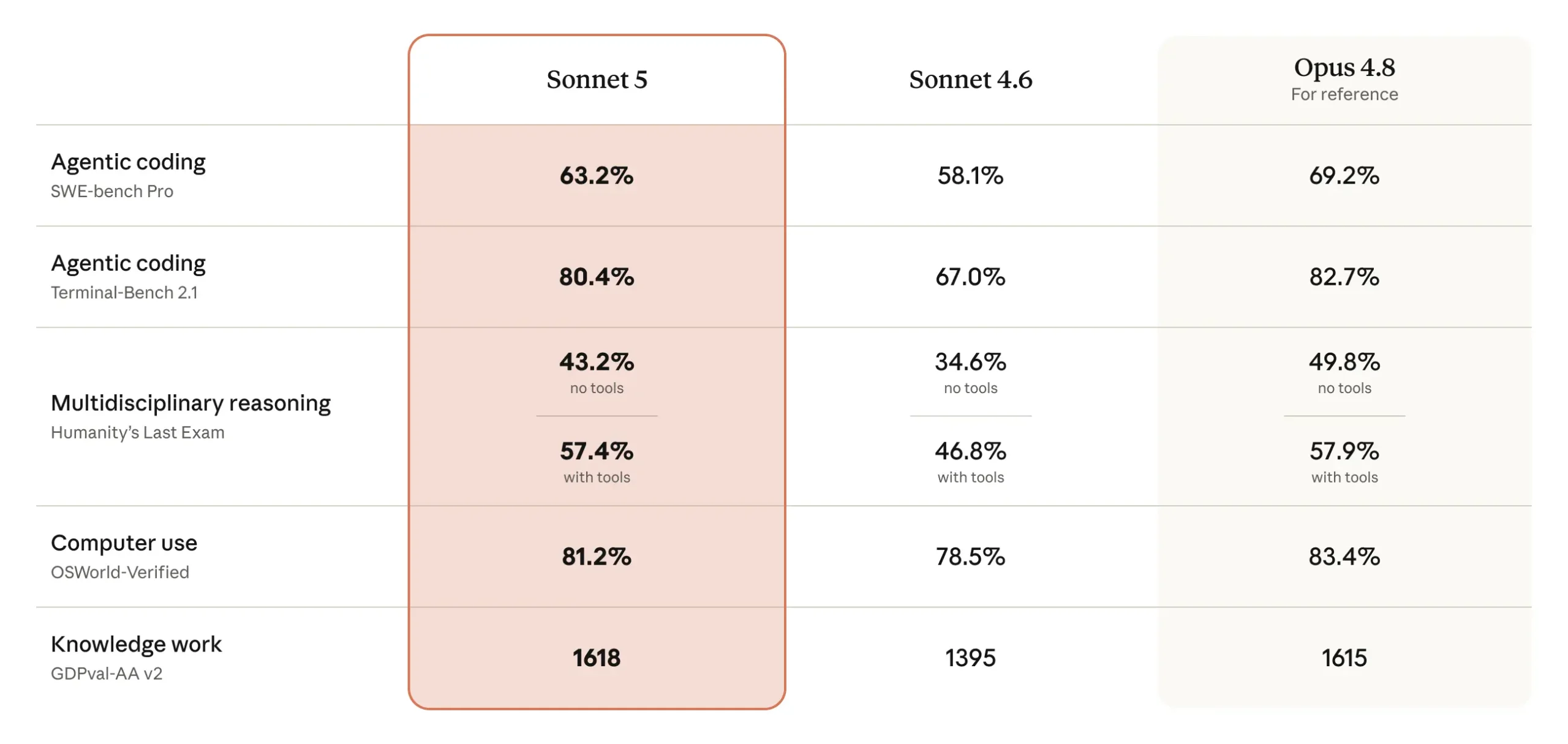
Claude Sonnet 5 is Anthropic’s newest Sonnet-class model built for advanced agentic AI capabilities.
Compared to Sonnet 4.6, it delivers major improvements in reasoning, coding, tool use, knowledge work, and autonomous task completion.
According to Anthropic, the model can plan complex workflows, verify its own work, and continue multi-step tasks more reliably than previous Sonnet models.
- Advanced reasoning capabilities
- Improved coding performance
- Better tool use with browsers and terminals
- Enhanced knowledge work
- Smarter autonomous task execution
Also Read: Claude Opus 4.7: The AI Tool That Could Reshape Web Design
Better Agentic AI Performance
One of the biggest upgrades in Claude Sonnet 5 is its agentic AI capabilities.
The model can use external tools like browsers and terminals while planning multiple steps toward a goal instead of simply responding to prompts.
Anthropic says Sonnet 5 performs much closer to Opus 4.8 on several agentic benchmarks while offering significantly lower operating costs. This gives developers more flexibility when balancing performance and budget.
- Plans complex workflows independently
- Uses external tools when needed
- Completes longer tasks with fewer interruptions
- Offers improved cost-to-performance efficiency
Improved Coding and Reasoning
Coding has always been one of Claude’s strongest capabilities, and Sonnet 5 continues that trend.
The model is better at writing code, debugging applications, solving reasoning tasks, and working across larger codebases. Anthropic also says the model frequently checks its own work before finishing tasks, helping reduce mistakes during longer workflows.
- Generate code faster
- Debug applications more accurately
- Solve complex programming problems
- Support large development projects
- Verify outputs before completing tasks
Safer Than Previous Sonnet Models
Performance isn’t the only improvement.
Anthropic has also strengthened safety in Claude Sonnet 5. According to its safety evaluations, the model produces fewer hallucinations, better resists prompt injection attacks, and is more likely to refuse malicious requests than Sonnet 4.6.
Cybersecurity safeguards are also enabled by default to help prevent misuse during sensitive tasks.
- Lower hallucination rates
- Better protection against prompt injection
- Improved refusal of unsafe requests
- Enhanced cybersecurity safeguards
Also Read: Introducing Claude Design by Anthropic Labs
Claude Sonnet 5 Pricing
Anthropic has introduced special launch pricing for Claude Sonnet 5 through August 31, 2026.
Introductory Pricing
- $2 per million input tokens
- $10 per million output tokens
Standard Pricing (After August 31, 2026)
- $3 per million input tokens
- $15 per million output tokens
The company says this pricing makes Claude Sonnet 5 one of the most affordable high-performance agentic AI models available today.
Availability
Claude Sonnet 5 is available across all Claude plans.
It is now the default model for Free and Pro users while also being available for Max, Team, and Enterprise customers. Developers can access the model through Claude Code and the Claude API.
- Free Plan
- Pro Plan
- Max Plan
- Team Plan
- Enterprise Plan
- Claude Code
- Claude API
Final Thoughts
With Claude Sonnet 5, Anthropic is making advanced agentic AI more accessible without requiring developers to pay flagship model prices.
Stronger reasoning, improved coding, enhanced safety, and competitive pricing make Sonnet 5 one of the most important AI model releases of 2026. Whether you’re building AI agents, automating workflows, or developing software, Claude Sonnet 5 offers a compelling balance of capability, safety, and affordability.
Frequently Asked Questions
What is Claude Sonnet 5?
Claude Sonnet 5 is Anthropic’s latest AI model designed for advanced reasoning, coding, tool use, and autonomous AI tasks. It delivers performance close to Opus-class models while offering a more affordable pricing structure.
How is Claude Sonnet 5 different from Sonnet 4.6?
Claude Sonnet 5 improves reasoning, coding, tool use, and agentic AI capabilities compared to Sonnet 4.6. It also offers lower hallucination rates, stronger safety features, and better autonomous task completion.
How much does Claude Sonnet 5 cost?
Claude Sonnet 5 is available at an introductory price of $2 per million input tokens and $10 per million output tokens until August 31, 2026. After that, pricing changes to $3 per million input tokens and $15 per million output tokens.
Who can use Claude Sonnet 5?
Claude Sonnet 5 is available for Free, Pro, Max, Team, and Enterprise users. It is also accessible through Claude Code and the Claude API, making it suitable for both individual developers and businesses.
Is Claude Sonnet 5 better for coding?
Yes. Claude Sonnet 5 offers improved coding, debugging, reasoning, and autonomous workflow capabilities. It can write code, use development tools, solve programming problems, and complete complex coding tasks more effectively than previous Sonnet models.